Consider these recent news headlines: “NYC Turns Back to Gas Buses After Finding Out the Hard Way That the Electric Versions Have Big Problems,” “As a Former Head of MI6 it’s Clear That Britain’s Climate Policy is Leaving Us Dangerously Exposed to Our Enemies,” and (3) “Spain: 74% of sex-crime suspects are foreigners in Basque Country.”
They come from three different Western nations and involve three dissimilar subjects — public transportation, national security, and violent crime — yet each news story exposes the real-world consequences of government failure:
In order to pursue “Net Zero” carbon goals, New York dumped a ton of money into electric buses that are too expensive and entirely unreliable for the city’s needs. Britain’s former top spy is finally ready to admit publicly that his country’s delusional obsession with “climate change” has devastated the United Kingdom’s capacity for industrial and energy self-sufficiency, rendering the former superpower dependent on foreign adversaries for future survival. Even though foreigners make up only 10% of the Basque region’s population, they account for 74% of rape arrests, 73% of homicide arrests, 95% of drunk-driving arrests, 80% of theft arrests, and 78% of violent robberies.
What’s so striking about these news stories is their “well, duh!” factor. An ordinary, rational person would have no problem predicting the failures of a citywide electric bus fleet, the offshoring of a nation’s critical industries, or open border policies that invite foreign invasion. Yet mayors, governors, and prime ministers have pursued these catastrophic programs anyway, while heads of espionage agencies and millions of government bureaucrats either support their harmful decisions or shamefully stay silent.
The middle article links to the transcript of a speech that Sir Richard Dearlove delivered to the Global Warming Policy Foundation in London last week. It was a good speech concerning an important subject, and Dearlove deserves some credit for articulating a point of view that goes against the powerful flow of “politically correct” Western orthodoxy. But he gave this speech from the comfortable perch of quasi-retirement with little to lose aside from a few honorary board positions. Where was his voice when he was in a position to actually do something about the U.K.’s suicidal energy policies?
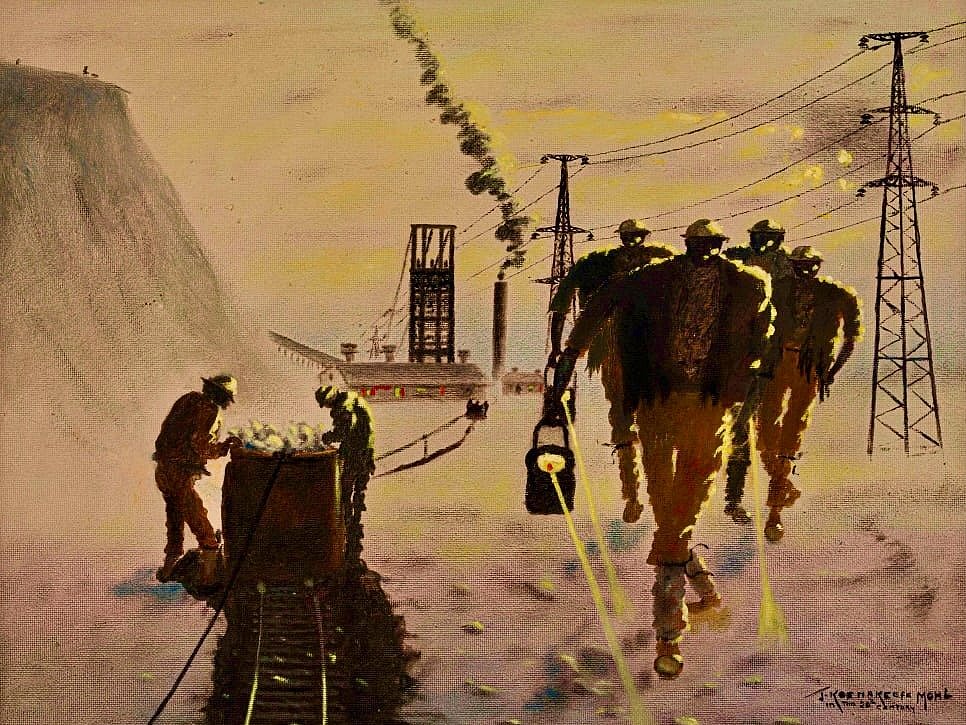
In his speech, Dearlove explained how his Cold War experiences taught him “that the country’s war-fighting potential resided in its industry, that our most vulnerable link was the fuel chain…and that our industrial base could be rebuilt and repaired.” Now, however, there is “very little industry left to protect, and we cannot rebuild non-existent industries which lie in foreign jurisdictions beyond our reach.” Dearlove concluded that the U.K. must “rebuild the strategic industries we require to ensure that we can defend our island fortress and be a reliable ally to friendly democracies around the world.”
These are absolutely true statements. Blue-collar workers throughout the West have been making these arguments for fifty years. Had an ordinary Brit with few credentials been in charge of MI6, that person would have been screaming profanities and ringing alarm bells long before the U.K. closed its last coal mines and steel factories. Shouldn’t that embarrass Britain’s “ruling elites”? And if it doesn’t, shouldn’t “ruling elites” be considered a danger to the public’s prosperity and security?
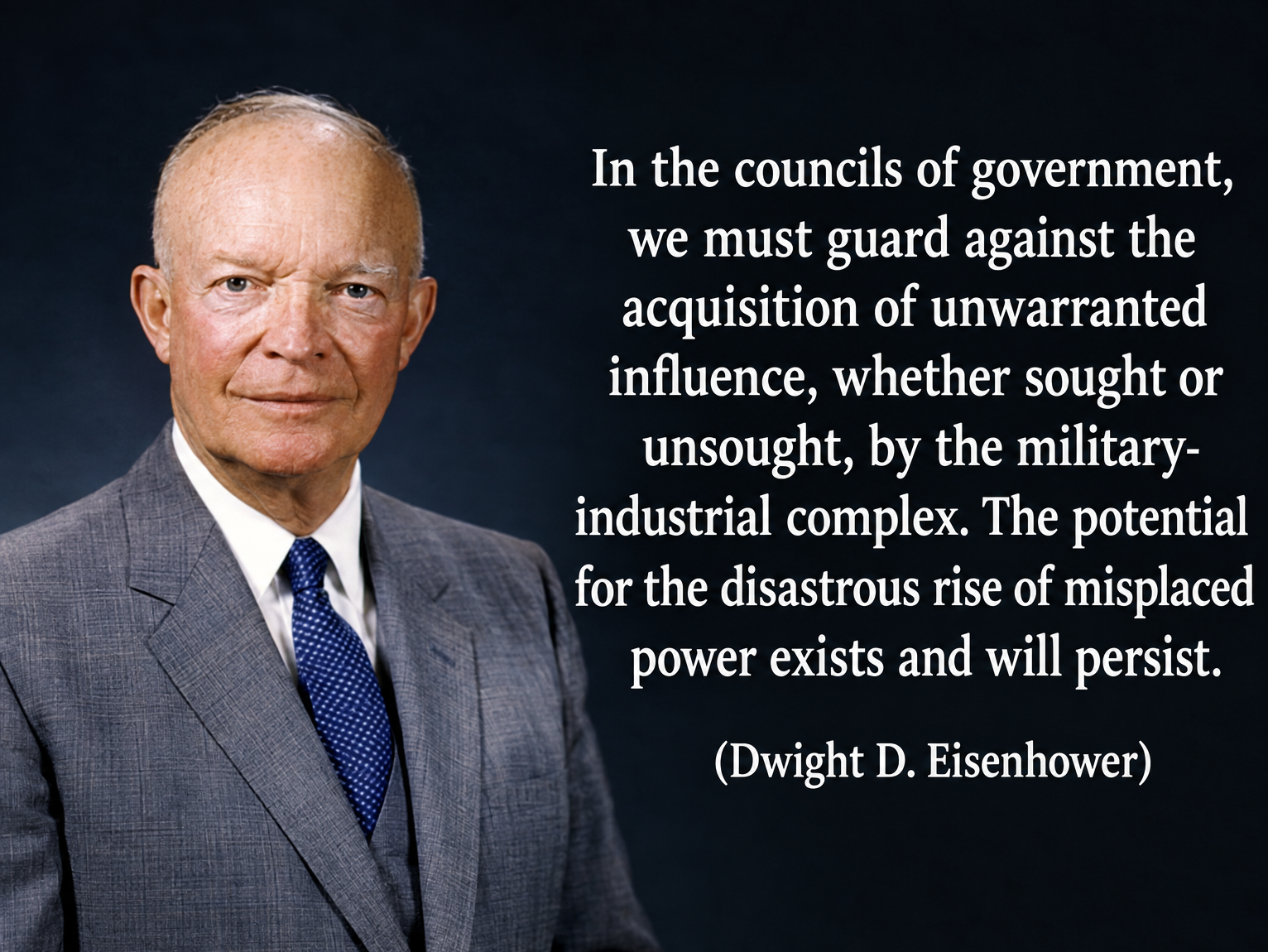
Long-overdue, post-career wake-up calls bring to my mind President Eisenhower’s 1961 Farewell Address during which he warned Americans against the growing dangers from an emerging “military-industrial complex.” Although his turn of phrase continues to be used sixty-five years later, it would have been nice if the former Supreme Allied Commander and five-star general had used his two terms as president of the United States to tackle that problem before it got completely out of hand. Eisenhower certainly had the expertise to see its destructive potential more clearly than most, but he chose to outline the threat on his way out the door and leave it for others to solve. Some historians believe that parts of the MIC had a hand in President Kennedy’s assassination, and if that is true, then Eisenhower’s failure to promptly act had extraordinarily far-reaching consequences that included the death of his successor.
The generations of Americans who were born after Eisenhower’s tenure have given him much credit for recognizing that the symbiotic relationship between Big Government and Big Business was evolving into an unconstitutional and anti-American oligarchy that we know today as the “permanent bureaucracy,” the “ruling class,” or the “Deep State.” Perhaps if the American general-turned-president had neutralized the Deep State in the first decade after WWII, we would not have endured some of the worst chapters in recent American history, including the Vietnam War, the debasement of the U.S. dollar, the FBI’s soft coup d’état against President Nixon, fifty years of “global warming” con games, sixty years of mass immigration from third-world nations, NAFTA’s industry-killing bloodbath, China’s entry into the WTO, the 9/11 Islamic terror attacks, the Global War on Terrorism, Obamacare’s government takeover of medicine, the Russia Collusion Hoax, the COVID information war against the Bill of Rights, numerous rigged elections decided by unlawful voters and mail-in-ballot fraud, multiple assassination attempts on President Trump, the assassination of Charlie Kirk, leftist-inspired violence against conservatives, and the Democrats’ manufactured AI fearmongering going on today. Diagnosing problems without taking concrete steps to solve those problems produces a perverse phenomenon: The worse unsolved problems become, the more prescient the person warning about them appears.
Toward the end of Dearlove’s speech, Britain’s former top spy argued that the government of which he was an integral part had monumentally failed: “The first responsibility of government is the safety of the nation. However, successive governments have forgotten this, and Britain is now caught in an energy trap of its own making. As with rebuilding our armed forces, it will take a significant national effort to extract us and bring us back to a position of safety. The task is urgent.”
This is certainly true. The question is why so many successive governments in the U.K. and across the West have betrayed their own citizens and made their nations much less safe. Because normal citizens would never have offshored their own industrial and manufacturing jobs to adversarial nations such as communist China. Normal citizens would not have conspired with transnational human trafficking gangs to import tens of millions of unassimilable illegal aliens. Normal citizens would not have imposed “green energy” regulations that make it harder for farmers to grow food and for businesses to pay their bills. Normal citizens would not mandate that unreliable electric vehicles replace internal combustion engines while power grids crash due to insufficient supplies of wind and solar energies. These kinds of policies are so obviously foolish and suicidal that only our credentialed “ruling class” could justify them.
Does that tell us that our bureaucrats are too stupid to keep our nations safe, as Dearlove rightly recognizes as the first responsibility of government? Or are these self-destructive national policies proof that Western bureaucracies are waging war against Western citizens? Certainly Western governments are guilty of failing their peoples. The only question remaining is whether their failures stem from a combination of incompetence and hubris or treason and malice.
As Western citizens ponder that question, they are quickly taking matters into their own hands. Spaniards in Ceuta are destroying government shelters built for foreign invaders. A British village has voted to secede from the U.K. after the government announced plans to house an army of foreign immigrants next door. The price of government betrayal might soon be the fall of a Western capital.
Recognizing problems is not good enough. Governments that cause more problems than they fix do not deserve to survive.
Source: American Thinker.