The former Soviet administrative unit that emerged as independent Ukraine in 1991 after the fall of the Soviet Union was bounded by the exact borders of the Ukrainian Soviet Socialist Republic (SSR). That is, it comprised a wholly unnatural polity whose borders and population had been assembled by successive Soviet leaders for the administrative convenience of their brutal communist dictatorship.
Once the external scaffolding of this Moscow disappeared, that construct quickly polarized along regional and linguistic lines. The red-and-blue electoral map below supplies the generic illustration: Western and central oblasts (blue) delivered overwhelming majorities to candidates oriented toward Ukrainian language and Western institutions, while eastern and southern oblasts (red) – from Kharkiv through the Donbas and along the Black Sea rim including Crimea – delivered equally lopsided majorities to candidates favoring closer Russian ties and greater status for the Russian language.
Accordingly, national results stayed reasonably close; regional electoral results did not. The pattern amounted to a standing de facto referendum for partition.
The blue territories of Galicia and Volhynia had spent centuries inside the Polish-Lithuanian Commonwealth and the Austrian Empire, developing under Greek-Catholic and later Polish institutions. The populations there had little affinity for both communism and Russian culture.
The red territories, by contrast, had been shaped by the Czarist Empire: Novorossiya, the Donbas, Kharkiv, and Crimea were settled or industrialized under Russian rule, with heavily Russian-speaking urban populations economically integrated with Russian economic markets and religiously tutored by the Russian Orthodox church.
Both zones carried scars from the depredations of the Second World War: The criss-cr0ssing of the lands first by the German occupation, then by Red Army reconquest. Those nightmarish experiences reinforced the older divergence.
In the first presidential election in December 1991 a recycled communist apparatchik, Leonid Kravchuk, won nationally with 61.6% of the vote on a national independence platform. Regional variation already existed – Kravchuk was stronger in the center and west, more pro-Russian candidates relatively stronger in the industrial east and Crimea.
But the simultaneous independence referendum that year and the popular relief from the oppression of Moscow rule masked the depth of the underlying split in the polity. So Kravchuk’s pro-independence moderation of 1991 did not last.
By the 2004 presidential election the cleavage had hardened. In the final December 2004 rerun, Viktor Yushchenko, the Ukrainian nationalist candidate, received 15.1 million votes (52.0%) while the pro-Russian, Viktor Yanukovych, received 12.8 million votes (44.0 percent). The national margin was modest. But inside the regions, the vote gaps were huge.
In Lviv oblast Yushchenko took 93.7%, in Ternopil 96.0%, and in Ivano-Frankivsk 95.7%. And across most of the western and central blue zone in the electoral map below his share exceeded 80 percent.
By contrast, Yanukovych, who was a Russian-speaker and native of the Donbass, won overwhelming margins in the red zones to the east and south. In Donetsk oblast, for instance, Yanukovych took 93.5% and in Luhansk, 91.2%.
Likewise, in Crimea overall he received 81.5% and in the great Russian Black Sea port of Sevastopol, he polled 89%. Across the broader red belt shown in the map below his majorities routinely surpassed 65–70 percent.
In short, 10-years before the Maidan coup of 2014 and 18-years before the Russian incursion of February 2022 to counter the Kiev government’s military assault on the Donbas (see below) presidential election voters were already signaling on which side they would line up. That is, once Washington’s blunderbuss intervention in February 2014 ruptured the tenuous cohesion of the artificial state that had been decreed by Lenin, Stalin and Khrushchev during the final 74 years of the region’s 1,000 year history.
In fact, the election results of 2004 and the 2010 did not require any reading of entrails or old-style Kremlinology: The oblasts shaped by Austrian and Polish rule delivered near-unanimous verdicts for the candidate promising European integration; the oblasts long integrated with the Russian imperial economy delivered near-unanimous verdicts for the candidate promising official status for the Russian language and renewed ties with Moscow.
For want of doubt, consider the result for the last presidential election (2010) before in their wisdom the Washington neocons and Empire Firsters smothered the incipient democracy in Ukraine during the phony Maidan uprising. It was an even sharper red/blue polarization.
In the February 2010 runoff the pro-Russian Viktor Yanukovych obtained 12,481,266 votes (48.9%) and Ukrainian nationalist, Yulia Tymoshenko, received 11,593,357 votes (45.5%). Again the country as a whole was closely divided.
Again, however, the regions were not. Western and central blue oblasts gave Tymoshenko 70–90 percent (Lviv and Volyn above 80% in many districts). On the other hand, southern red oblasts gave Yanukovych 70–90 percent (Donetsk above 90 percent, Crimea and Luhansk in the high 70s to low 90s).
In short, the candidates had changed, yet the map remained essentially the same, forewarning still again of a polity not built to last.
Self-evidently, these close national outcomes coexisting with extreme regional super-majorities showed that Ukraine’s unitary constitution was aggregating two incompatible electorates. Because neither camp could permanently dominate the other, any sudden external shock – whether a Russian offer of preferential terms or a Western association agreement – threatened to tip the equilibrium into open conflict.
The populations of the blue zone viewed European integration as the fulfillment of their historical trajectory; the populations of the red zone viewed it as dispossession. When the Euromaidan crisis of 2013–2014 and subsequent Washington intervention supplied that shock, the latent partition demand became active civil conflict.
The administrative state confected by the Soviets proved unable to contain the regional and linguistic polarization its own history had entrenched. The red-and-blue map was advance notice that the post-Soviet construct was not built to last.
In fact, the equilibrium was fatally shattered in the winter of 2013–2014.
Protests began in Kyiv in November 2013 after President Viktor Yanukovych suspended signature of an association agreement with the European Union in favor of a more economically attractive deal being proffered by Moscow. What started as a demonstration against that decision escalated, under conditions of police violence and counter-mobilization, into a sustained occupation of central Kyiv and, ultimately, the flight of president Yanukovych on 21–22 February 2014.
Needless to say, these events are described by Maidan supporters as the Revolution of Dignity and by critics as an illegal coup. But about the immediate political consequence there can be no doubt: At Washington’s instigation, incipient democracy in Ukraine was quashed and replaced by an unelected interim government dominated by figures pre-approved by the State Department.
Indeed, US officials were openly and actively engaged in the coup aimed at regime change. Assistant Secretary of State Victoria Nuland led the charge, and there was no doubt about her affinity for Empire First meddling in favor of Washington’s dictates whenever and wherever it served the neocon agenda – a unipolar national security agenda heavily fashioned by the Kagan clan which she had married into.
The latter included neocon guru Robert Kagan, who was her husband; military historian Fredrick Kagan, who was Robert’s brother; and thank tank propagandist Kimberly Kagan, who was married to Fredrick and ran the Institute for the Study of War, a military-industrial complex (MIC) financed operation which was in the business of confabulating cases for US intervention and military engagement across the length and breadth of the planet.
Under Victoria Nuland instructions, US Ambassador to Ukraine, Geoffrey Pyatt, made repeated visits and public statements supporting the protesters’ demands. On 28 January 2014 Senator John McCain, Washington’s leading neocon noisemaker, even appeared on the Maidan stage alongside opposition leaders and told the crowd that America stood with them.
In fact, a leaked telephone conversation between Nuland and Pyatt in early February captured them discussing which opposition politicians should enter a prospective new government. Nuland’s remark “Yats is the guy” – referring to Arseniy Yatsenyuk as the prospective leader of the coup – became the most widely cited fragment. The same call also contained her blunt dismissal of European Union hesitations (“Fuck the EU”).
After president Yanukovych’s flight, the interim authorities in Kyiv included some mainstream pro-European politicians, but also representatives of smaller but highly visible far-right nationalist groups. To wit, Svoboda (All-Ukrainian Union “Freedom”), which had won roughly 10 percent of the vote in the 2012 parliamentary elections, received several ministerial and senior posts in the first Yatsenyuk cabinet, including the deputy prime ministership, the ministry of defense (briefly), and the prosecutor-general’s office.
Likewise, Right Sector, an umbrella of radical nationalist and neo-Nazi-leaning militias that had supplied street fighters during the final Maidan clashes, remained outside formal cabinet rank yet retained armed formations and political influence in the new government.
Both formations drew explicitly on the legacy of the WWII Organization of Ukrainian Nationalists (OUN) and its leader Stepan Bandera. Bandera’s OUN-B faction had collaborated with the invading German forces in 1941 in the hope of establishing a Ukrainian state and notoriously participated in anti-Jewish pogroms in western Ukraine.
For instance, the OUN-B, together with local Ukrainian militia and encouraged by German forces, carried out mass violence against the Jewish population of Lviv in 1941. Over several days, thousands of Jews were beaten, humiliated, and murdered in the streets, in prisons, and in improvised killing sites. Estimates of the dead in the Lviv pogroms alone run from several thousand to more than 6,000. Parallel pogroms and massacres occurred in other western Ukrainian towns in the same weeks.
Needless to say, Svoboda and Right Sector leaders and rank-and-file members regularly commemorated Bandera, displayed the red-and-black OUN flag, and employed the slogan “Glory to Ukraine – Glory to the Heroes,” the wartime greeting of the OUN and the Ukrainian Insurgent Army (UPA).
Some Right Sector units and associated volunteer battalions (later integrated into the National Guard) also used Wolfsangel, swastika-derived, or other neo-Nazi iconography alongside OUN symbols. Party literature and public statements from Svoboda figures in this period contained ethnic-nationalist, anti-Russian, and, in documented cases, antisemitic formulations consistent with the historical OUN tradition.
To be sure, these groups did not control the majority of the post-Maidan government – the premiership and most economic portfolios remained with Yatsenyuk’s Batkivshchyna and allied pro-European parties – but their presence in official posts, their armed role on the Maidan, and their open veneration of Bandera and the OUN were widely publicized in Russian-speaking eastern and southern regions.
For populations that had given Yanukovych 80–90 percent majorities and that associated Bandera’s movement with wartime collaboration and ethnic violence, the elevation of these symbols and personnel supplied concrete evidence that the new authorities in Kyiv represented a hostile nationalist project. As explained below, the combination of the language-law vote, the Odessa events, and the visible role of Svoboda and Right Sector therefore converted long-standing electoral polarization into an immediate political rupture.
As it happened, the National Endowment for Democracy (NED) and other U.S.-funded organizations had for years supported anti-Russian agitation in the guise of Ukrainian civil-society and election-monitoring groups.
Indeed, in a December 13, 2013 speech to the U.S.-Ukraine Foundation on the eve of the Kiev street violence, Victoria Nuland stated that the United States had “invested over $5 billion” in Ukraine since independence in 1991. She claimed the purpose had been “to assist Ukraine in these and other goals that will ensure a secure and prosperous and democratic Ukraine”, which, of course, was neocon speak for regime change.
In any event, after Yanukovych’s departure the Verkhovna Rada (parliament) installed an interim cabinet headed by Yatsenyuk. Several posts went to members of Svoboda and other nationalist formations that had been visible on the Maidan, including Right Sector and related groups which had supplied armed contingents during the final clashes.
As indicated, these parties and militias espoused ethnically defined Ukrainian nationalism, employed historical symbols associated with the Organization of Ukrainian Nationalists, and, in some cases, had records of anti-Russian and antisemitic rhetoric. Their presence in the new government and the rhetoric surrounding the transfer of power alarmed Russian-speaking populations in the east and south, who had voted heavily for Yanukovych.
Early actions by the post-Yanukovych authorities reinforced that alarm. On 23 February (2014) the Rada voted to repeal the 2012 language law that had permitted Russian to be used as a regional official language in oblasts where it was spoken by a substantial minority. Although acting President Oleksandr Turchynov declined to sign the repeal and the measure never took full effect, the vote itself was widely reported in the east as an attempt to downgrade Russian.
In Odessa on 2 May 2014 street clashes between pro-unity and pro-Russian demonstrators ended with a fire in the Trade Unions House that killed more than forty people, most of them from the pro-Russian side. While accounts differ on who started the fire and whether security forces failed to intervene, the episode was interpreted in Donbas and Crimea as evidence that the new authorities in Kyiv would not protect Russian-speaking activists.
These developments converted the long-standing electoral polarization into an active separatist crisis. In March 2014 Crimea, already the most strongly pro-Russian region on the electoral maps, held a referendum which resulted in a 80-20 vote in favor of secession, followed by Russian annexation.
Likewise, in April armed groups seized buildings in Donetsk and Luhansk oblasts—the same oblasts that had given Yanukovych 90 percent-plus majorities – and proclaimed “people’s republics.” The Ukrainian government’s subsequent military response, labeled an anti-terrorist operation, marked the beginning of open armed conflict. The populations that had repeatedly delivered 80–90 percent majorities for pro-Russian candidates now possessed both a political grievance (the abrupt change of government in Kyiv and the perceived threat to language and regional status) and, in the east, external Russian support.
The Maidan transfer of power therefore did not create the red-blue cleavage; the electoral record of the preceding two decades had already mapped it.
What the Maidan crisis supplied was a sudden shock – diplomatic, political, and symbolic – that convinced a critical mass of voters in the red regions that continued participation in a unitary Ukrainian state oriented toward the West no longer served their interests. The result was the transformation of a chronic electoral polarization into territorial separatism and civil war.
Diplomatic efforts to convert the Minsk documents into a functioning settlement collapsed under the weight of mutually incompatible interpretations. Kyiv maintained that any special status for the Donbas districts could be granted only after Ukrainian authority was restored and elections held under Ukrainian law.
The leaderships in Donetsk and Luhansk, backed by Moscow, insisted that the political provisions – constitutional entrenchment of special status, amnesty, and local elections – had to come first. Successive Ukrainian governments after 2014 treated the required constitutional changes as politically toxic; parties that had drawn their strongest support from the blue electoral regions viewed concessions to the red regions as a reward for armed separatism.
Russian officials, for their part, described Minsk as the minimum condition for freezing the conflict and repeatedly charged that Ukraine was using the delay to rearm. By late 2021 the process was widely regarded as moribund.
In the same period Russian military and political spokesmen stated that their intelligence services assessed a growing risk of a large-scale Ukrainian operation aimed at retaking the breakaway territories. They pointed to increased Ukrainian troop concentrations, the delivery of additional Western anti-tank and artillery systems, and public statements by Ukrainian officials rejecting the political track of Minsk.
In fact, OSCE Special Monitoring Mission data document a marked rise in ceasefire violations and explosions along the Donbas line of contact in the weeks before the February 2022 invasion. While daily counts fluctuated, the monitors recorded hundreds of violations in late December 2021 and early January 2022.
The tempo increased further in February. On 18 February the Mission logged more than 1,400 explosions across Donetsk and Luhansk regions in a single day (553 in Donetsk and 860 in Luhansk) and more than 1,500 total ceasefire violations, a sharp jump from the 870 violations and 654 explosions recorded the previous day.
Ukrainian and separatist forces each accused the other of initiating the heavier artillery and mortar fire. While the OSCE reports themselves do not assign responsibility, they do confirm the huge quantitative surge in kinetic activity in the final days before Russian recognition of the two republics and the subsequent full-scale intervention.
Moreover, this sharp early 2022 escalation occurred against the backdrop of stalled Minsk implementation and heightened Russian warnings about a possible Ukrainian offensive.
Moscow’s public warnings escalated accordingly. President Putin and other senior figures declared that any attempt to resolve the Donbas question by force would cross a red line and that Russia would not remain passive if the Russian-speaking population of the region faced a renewed offensive.
On 21 February 2022 Russia formally recognized the independence of the Donetsk and Luhansk republics and concluded mutual-assistance treaties with them. Three days later Russian forces entered Ukraine from the north, east, and south.
The Russian government presented the operation as a defensive measure to protect the populations of the two republics, to halt what it called the militarization of Ukraine, and to prevent the country’s further integration into NATO.
Viewed against the longer electoral record, the 2022 rupture appears as the violent culmination of a cleavage that the post-1991 state had never resolved. The same eastern and southern oblasts that delivered 80- and 90-percent majorities to Viktor Yanukovych in 2004 and 2010 became the core of the armed separatist entities after 2014.
Populations whose historical experience had been shaped by Russian imperial settlement, Soviet industrialization, and the predominance of the Russian language confronted a post-Maidan government whose electoral base and symbolic repertoire were rooted in the western regions formerly under Austrian and Polish rule.
The failure of Minsk left no agreed mechanism for translating that regional divergence into a stable political arrangement. When great-power competition—U.S. and European support for the post-Maidan authorities on one side, Russian security demands on the other – intensified, the unresolved internal fracture supplied both the pretext and the geography for full-scale war.
In the framing that treats the post-Soviet Ukrainian state as an administrative construct of comparatively recent origin, the sequence from the April 2014 clashes through the collapse of Minsk to the February 2022 invasion illustrates the difficulty of maintaining a unitary polity over populations whose voting patterns, language use, and external orientations had diverged for decades.
The external alliances and security guarantees sought by successive governments in Kyiv, and the counter-pressure exerted by Moscow, converted a chronic regional standoff into an internationalized conflict. Whether that outcome is ascribed primarily to Russian revisionism, to the post-Maidan government’s refusal to implement the political clauses of Minsk, or to the structural incompatibility of the two electoral Ukraine’s, the red-and-blue maps of the independence period remain the clearest pre-war evidence that the cleavages later expressed in armed separatism were already present, measurable, and deep.
By any form of rational consideration, there is no reason for a continuance of the proxy war against Russia in faux state of “Ukraine”. Russia is not military threat to the American homeland and the internal governance on the lands of ancient empires is none of Washington’s business.
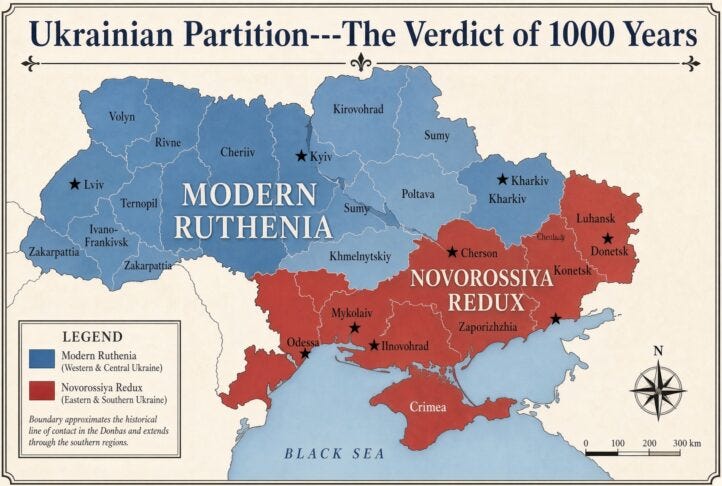
Indeed, 1,000 years of history prove there never was an organic nation of ‘Ukraine” across the territories depicted below. The propinquity of the red and blue regions is nothing more than the desultory work of communist dictators in Moscow who ruled for just 7% of that history.
So, any fair reading says that history – both ancient and recent—has already decided the geography. That is, quiet the guns, dismiss the Washington neocons and let the parties partition these long-suffering lands and peoples – —perhaps along the lines shown below. They track both the history and the current line of contact in the war.
New states that might be described as Modern Ruthenia and Novorossiya Redux would be far preferable for all parties concerned than another $100 billions of destruction and tens of thousands more dead – on top of the 400,000 on each side that have fallen for no valid reason.
And the bonus would be the elimination of the current confrontation between the world’s two most lethal nuclear armed nations.That, along with a dramatic opportunity to bring a major needless outpost of the Empire home.
Source: AntiWar.com.