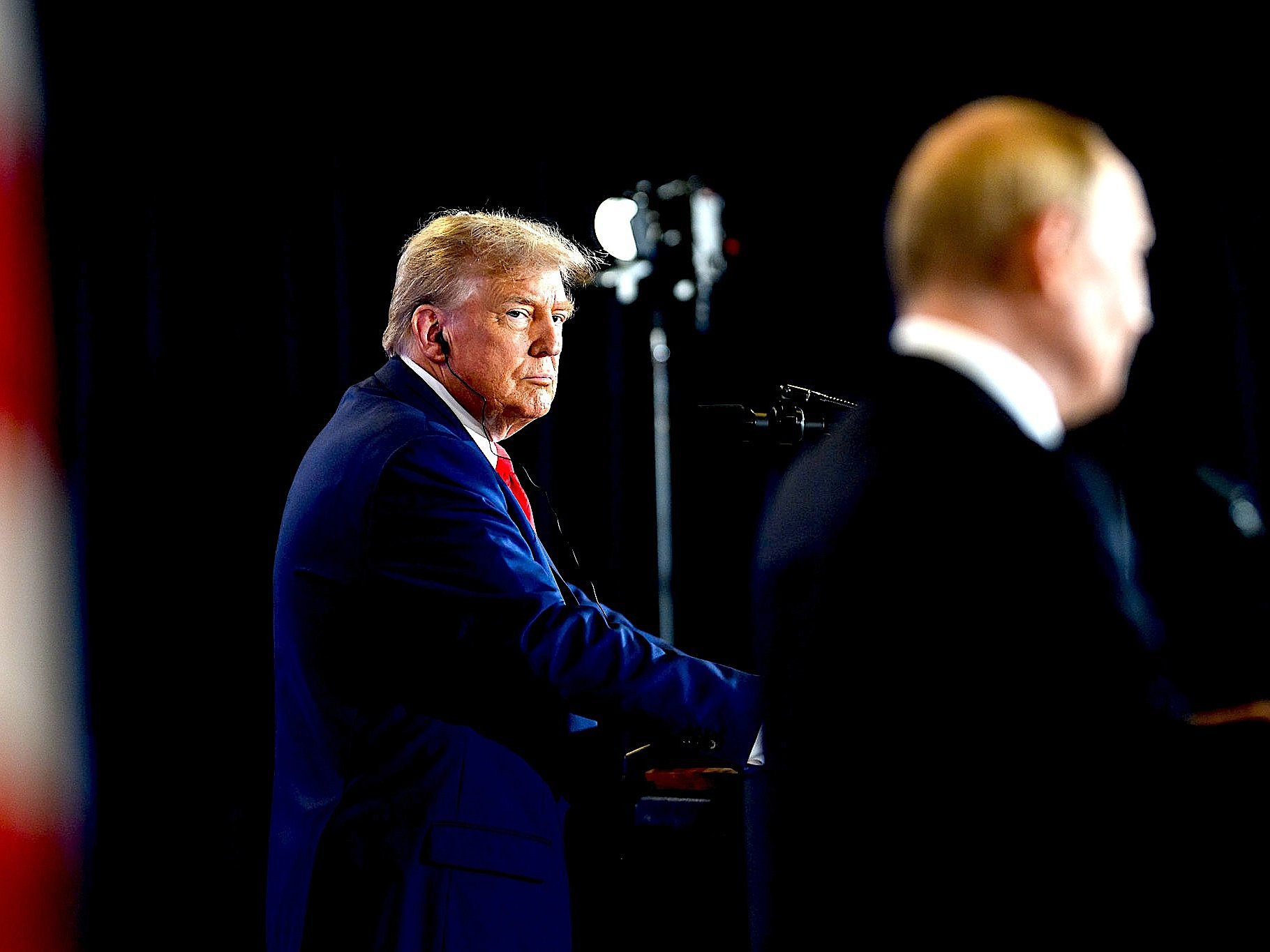
Last spring, when it was already evident the ruling Republican Party was losing favor with American voters and Donald Trump’s star had begun to fade, the 47th president threatened to cancel the legislative elections scheduled halfway through his second term. Any such diktat would have precipitated a constitutional crisis of historical magnitude, to state the obvious. While President Trump ignores the Constitution as a matter of course, abolishing an election proved a breach too far. Those Americans who insist on voting will duly go to the polls Tuesday. For the record, I will not be among them.
Political contests in America have had the character of free-for-all brawls more or less since the nation’s founding. There is a long record of elections that have been stolen, bought, or otherwise corrupted so as to suppress the popular will. Among the more infamous of these recent occasions was the “hanging chads” fiasco in Florida, which, in broad daylight, took the 2000 election away from Al Gore and gave it, fatefully enough, to George W. Bush. But the 2026 midterms —bitterly fought and closely watched, as Trump’s fate as president, and therefore America’s, hang in the balance — are the most adulterated elections in my lifetime. I relate this judgement without hesitation.
Having spent most of my professional life as a correspondent abroad, I have often wondered what the American political process looks like to those accustomed to lawful procedures, to restrictions on the money candidates can spend, on how long they can campaign before an election, on how much they can use mass media to advertise themselves — altogether on accepted limits on how much candidates can lie about and smear each other. I have found this a useful exercise. It is a reminder of how far, even in a political culture wherein bamboozling voters has long been common practice, our greatly distressed republic has fallen.
On reflection this seems to me inevitable. I have long argued, taking the lesson from Twain, Du Bois, and others, that Americans can have an empire abroad or democracy at home but not both. This has been the nation’s choice since it became a global power with the Spanish–American War at the conclusion the 19th century. America’s purported leaders made their choice long before Donald Trump came along. The mark of our time is how bitterly obvious this choice is. Among the striking features of America’s political life, notably but not only during the Trump II years, is the extent to which the conduct of empire and the dismantling of America’s never-fully-functional democracy have been normalized, broadly accepted as the what-is, the reality Americans must live with, the reality amid which they vote. This reality has landed with a thud during the 2026 political season, at least for some among us. In fact it has arrived not suddenly but over a long time such that most of those who will go to the polls Tuesday have not noticed, like the frogs in the pot coming to a boil, that they effectively endorse the collapse of the very democracy in which they presume to participate.
The 2026 midterms are a little like second marriages, in my view — the triumph of hope over experience. And, so, some notes from the land where there are none of the above-noted limits and where, it is far from unheard-of, law can be broken or bent beyond recognition in the cause of the hyper-ambitious, those obsessed with power — where money has the loudest voice by many decibels and where success is the ultimate prize and it does not matter how one achieves it.
Money as a Form of Speech
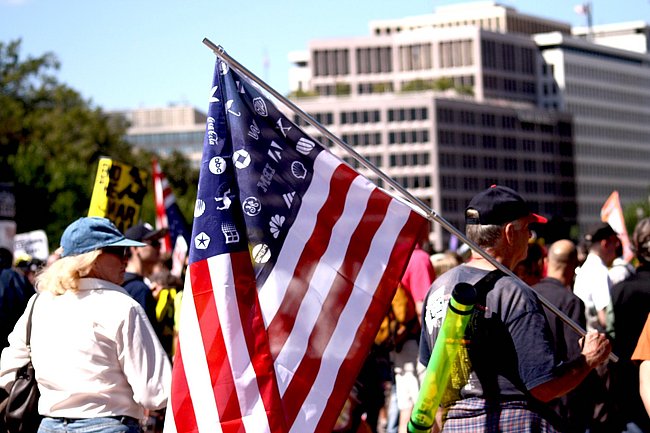
Corporate America flag at an antiwar protest in September 2007, in Washington, D.C.
Once upon a time the U.S. Congress debated whether to limit the amount of money spent in support of a given candidate for office. In hindsight I doubt those debates, which date to the post–Watergate 1970s, were ever so sincere as they appeared at the time, given sitting legislators were called upon to pass laws greatly to their disadvantage. Be this as it once may have been, there has been no serious consideration of campaign finance reform since the Supreme Court, in an utterly irrational decision handed down in 2010, ruled that money is a form of speech and, so, cannot be restricted.
Let me repeat this last point, so dumbfounding do I find it: In America money counts as speech, and the First Amendment of the Constitution inscribes free speech as an inalienable right.
On Oct. 28, the Federal Election Commission, the F.E.C., reported that candidates seeking office in the midterms have spent $3.2 billion on their campaigns — $2.02 billion by those running for seats in the House of Representatives and $1.18 billion by those running for the Senate.
The big spenders used to be unions and various lobbies — manufacturers of all kinds, farmers, health insurers, Wall Street. While these constituencies still write checks, Americans now speak of “the donor class,” which is comprised primarily of Silicon Valley billionaires, A.I. masterminds, media moguls, and —let us not leave out these diabolic obsessives — wealthy Zionists and the Israel lobbies, A.I.P.A.C. chief among them. To finish the thought, Silicon Valley billionaires, media moguls, and rich Zionists are more than seldomly the same people.
Last week the 2026 political cycle surpassed the previous record to become the most expensive political in American history. What strikes me most is how matter-of-factly the utterly objectionable presence of this kind of money in American politics is reported in corporate media. “Where the Parties Are Outspending Each Other in the Midterm Ad War” was a headline in The New York Times last week. This, deadpan reporting of a wholly undemocratic reality, is typical. It is implicit in the mainstream media coverage that whichever side raises more money is likely to win on Nov. 3 and this, the what-is, is as it should be.
The Times, incidentally, did its own calculations of the money washing around in the midterm contests. It seems those running for Senate seats have spent $2.4 billion this time around, more than double what the F.E.C. reported. By the Times’ reckoning, candidates for office in the 2026 midterms will have spent $3.9 billion before they either win or lose.
Festival of Gerrymandering
The practice known as “gerrymandering” is named for Elbridge Gerry, who, as governor of Massachusetts in 1812, signed a bill that redrew the state’s voting districts to the advantage of the Democratic–Republican Party, the ancestor of the Democratic Party of today. The district that resulted took the shape of a salamander, and hence the term as we have it.
Congressional districts are redrawn after the once-a-decade national census in America if redistricting is necessary due to shifts in population. But the cynical misuse of redistricting has been a phenomenon since Governor Gerry’s day. If a district has a high concentration of minorities likely to vote Democratic, say, a Republican administration can gerrymander it so the Democratic vote is diluted. The two features of gerrymandering to note here are they are typically done according to questionable interpretations of law and they are without exception forms of political corruption.
The 2025–26 political season has been a festival of gerrymandering. There are no innocents in this story. Six states—California, Florida, North Carolina, Ohio, Tennessee, and Texas—have all redrawn districts to the advantage of one party or the other. In three more—Alabama, Louisiana, and Utah—districts were gerrymandered after either Republicans or Democrats went to court to redraw the electoral maps; Missouri has a redistricting plan, but it is on hold pending a popular referendum. More gerrymandering, I should add, is due in 2027 and 2028 in anticipation of the presidential elections in the latter year.
Gerrymandering can distort the will of voters, as it has—and was meant to do—since Elbridge Gerry invented the practice. In the midterms, to cite one example, up to six black members of the House could lose their seats solely in consequence of politically motivated redistricting. The Supreme Court is one factor that has produced this rash of gerrymandering. Having drifted radically rightward in recent years, the Court has systematically weakened the 1965 Voting Rights Act, passed amid the rising influence of the civil rights movement. More immediately, much more immediately, President Trump has run a state-by-state gerrymandering operation since the start of his second term. And what goes around comes around: California, which adopted a new congressional map last year, is a heavily Democratic state. More redistricting — gerrymandering by any other name — is due in California before the 2028 elections.
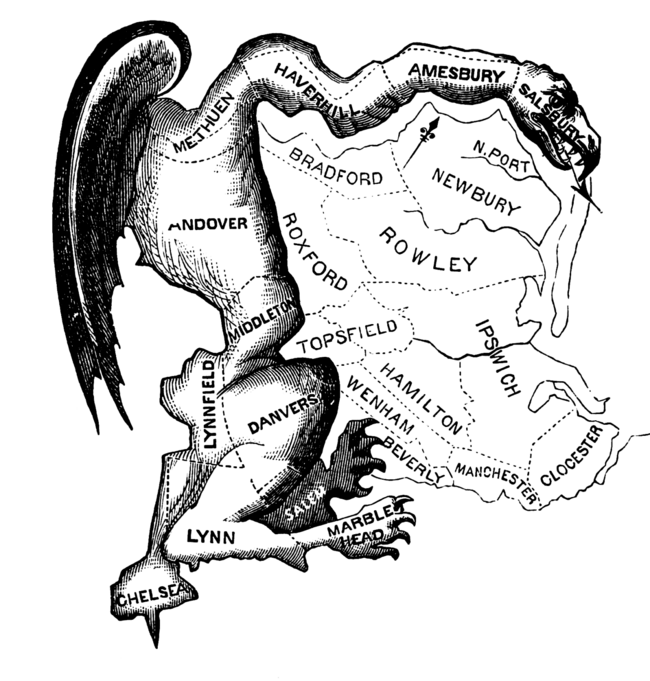
Political cartoon in The Boston Gazette on March 26, 1812, satirizing the odd shape of a state senate district Essex County, Massachusetts, after gerrymandering by depicting it as a strange animal with claws, wings and a dragon-type head
One of the more preposterous farces of this political season has unfolded in Alaska. The state’s ranked-choice system, an oddity in American politics, permits four candidates, two from each party, to stand for election. In this case the incumbent Republican senator defending his seat is named Dan S. Sullivan. Then last spring a retired schoolteacher from a small fishing village announced — almost literally out of nowhere — that he would run against Dan S. Sullivan, also as a Republican. His name is Dan J. Sullivan.
Today the Democratic challenger for Elbridge Gerry’s Senate seat, Mary Peltola, who previously had a seat in the House, will run as the sole Democrat in the election against the two Sullivans, Dan. S. and the arriviste Dan J. The near-inevitability of confusion among Republican voters, and so a dilution of incumbent Dan S.’ support, should require no explanation.
The Justice Department, a creature of President Trump since the day he took office in January of last year, filed a lawsuit last week seeking to block certification of the election result if it can be demonstrated, however this might be accomplished, that Dan J.’s presence on the ballot cost Dan S. votes.
Until this week the Democrats affected the see-hear-speak no evil pose of the sanzaru, the three wise monkeys of the Japanese folk tale. Then Peltola’s former campaign manager, who was fired in August, sprang a leak. On Wednesday The New York Times published her account of the long, vast conspiracy inside the Democratic machine to find as many Dan Sullivans as there were in Alaska and get one of them to run as a Republican against Dan. S. “Alaska voters need to know,” Elisa Rios told the Times.
Americans need to know, I would say. This is the system in which they are invited to participate.
What will transpire if Mary Peltola wins is anyone’s guess. I would anticipate lawsuits without end. And it turns out that subterfuge of this kind to dilute a candidate’s support — the use of “third-party spoilers,” as the Times puts it — is a longstanding trick of which both parties have availed. And there are variations. In Ohio Republicans have reportedly spent more than $2 million promoting one Greg Levy to run against Jon Husted, the incumbent Republican, alongside Sherrod Brown, a Democrat who has mounted a serious challenge against Husted. Greg Levy is the candidate of a who-ever-heard-of-it group called the Party for Socialism and Liberation. The hope is that Levy can peel enough “progressives” away from the Democrats to swing a close election to Husted.
Only in America, Land of Opportunity.
Tracking AIPAC Retreat
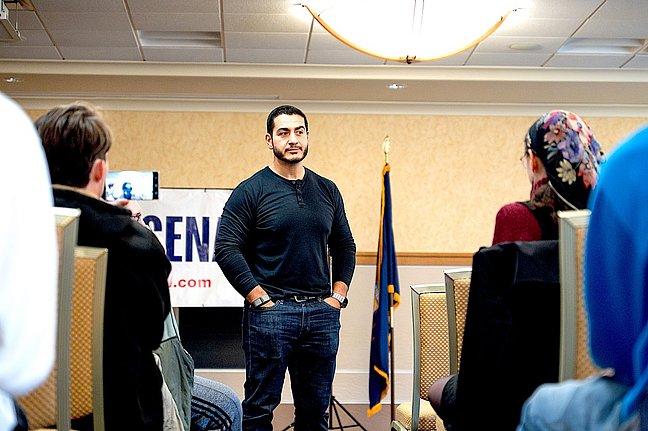
Dr. Abdul El-Sayed at a campaign event at Michigan Technological University in 2025.
At this point the American–Israel Public Affairs Committee, A.I.P.A.C., has corrupted all 435 members of the House and all 50 Senators, with rare and honorable exceptions. This reflects a systematic influence-buying operation that spans decades. At long last, and due in no small part to the Zionist regime’s campaigns of terror in Gaza, the West Bank, Lebanon, and lately Iran, A.I.P.A.C. seems to be getting its comeuppance, its just desserts. Now that its once-hidden machinations are exposed to the light of day, a decisive number of voters decline to support politicians who receive A.I.P.A.C. donations. There are now two websites, AIPAC Tracker and Track AIPAC, whose business it is to tell voters which candidates and sitting legislators take A.I.P.A.C. money and how much they take in each case.
It was only recently that A.I.P.A.C. put any money at all directly into elections: It invested its millions in advertising and propaganda, having bribed or coerced more or less all candidates running. Only in the past few years, with the tide running against it, has it felt compelled to begin putting funds into campaigns. A.I.P.A.C. does not divulge its political spending, but available evidence indicates it has been in the hundreds of millions of dollars during this year’s midterm campaigns.
At the same time, the 2026 political season has made it perfectly clear that, since the events of Oct. 7, 2023, accepting A.I.P.A.C. money has changed from an advantage to a liability. The Senate race in Michigan is a celebrated case. A Muslim physician named Abdul El–Sayed, an outspoken critic of the Zionist state, defeated Haley Stevens, a no-longer-happy recipient of roughly $30 million in A.I.P.A.C. funds. Opposition to Israel’s genocide, which El–Sayed calls by its name, is central to his campaign — as apologies for “the Jewish state” were to Stevens’. The vanquished Democrat spent last week attempting to sabotage the El–Sayed campaign under the guise of supporting it. Then Stevens went all the way, shifting her endorsement, such as it may matter, to Mike Rogers, the Zionist Republican running against El–Sayed. Thirty million dollars goes a long way and keeps on going.
Lately A.I.P.A.C. has taken to obscuring its funding via its perversely named subsidiary, the United Democracy Project. And, Zionist propagandists never missing a trick, it attacks opponents in advertisements not for their criticism of Israel but for some other, usually minor position. Candidate So-and–So opposes, say, controls on the prices of prescription medications, an A.I.P.A.C. advert will state, never mentioning that candidate So-and–So is vociferously against the Zionists’ aggressions. It is a clever blind.
This past week, something interesting. A.I.P.A.C. announced that it will no longer publicly endorse candidates, make direct contributions to them, or otherwise designate funds intended to go toward their campaigns. It clearly intends to continue corrupting elections as it has these past decades: In addition to the United Democracy Project, it now resorts to online donation portals, shell P.A.C.s, and other methods to obscuring flows of “dark money.” I read A.I.P.A.C. as in retreat nonetheless. Have Americans and those seeking their votes at last begun to excise the cancer of the Israel lobbies from the body politic? Any such surgery will take years, but it is pleasing even to pose the question.
Tricky Dicks
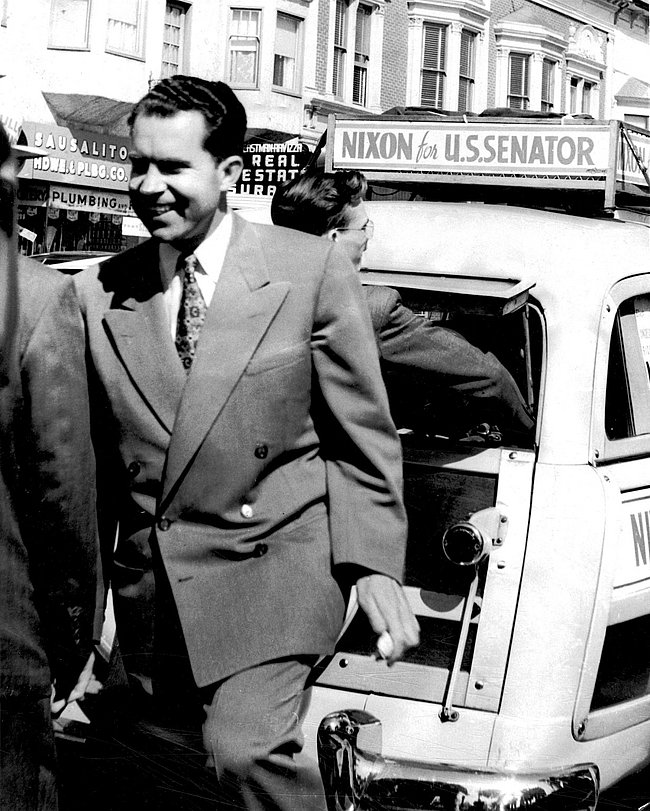
Richard Nixon campaigning in Sausalito, Calif., during the primary of the 1950 Senate race.
Readers of a certain age may recall the fierce and filthy campaign Richard Nixon waged in 1950 in pursuit of a Senate seat representing California. His opponent was a formidable Democrat named Helen Gahagen Douglas, and the race was close. Nixon went straight to the gutter. Labeling Gahagen Douglas a crypto–Communist, “pink right down to her underwear,” Nixon’s people infamously distributed hundreds of thousands of pink flyers to this effect. This was the early Cold War, remember, when attacks of this kind could be fatal condemnations.
Seventy-six years ago next week, Nixon trounced Gahagen Douglas, who never again sought public office. It was the victory that launched Nixon as a national figure. And it earned him the nickname that followed him the rest of his life, “Tricky Dick.”
There have been Tricky Dicks galore during the 2026 campaign season. Dr. El–Sayed is the subject of incessant Islamophobic attacks because of his faith, whose secret intent is to introduce Sharia law in Michigan. Trump has him down as “a vicious, violent jihadist”—the post–11 September variation on the Reds-under-the-bed theme of the McCarthyist 1950s. Elsewhere, James Talarico, running for the Senate as a Democrat in Texas, is “accused”—it seems the word these days—of being gay, or vegan, or strangely sympathetic to transgender children. Adam Hamilton, a Kansas Democrat who is reportedly 9 percentage points ahead of the Republican incumbent in the Senate, is “probably grooming children.” Almost all of this comes from the G.O.P. side and is frequently well below the belt, if this is my phrase. But we cannot leave out the Democrats. Gavin Newsom, the California governor with outsized ambitions, has taken to “charging” his rightist critics with being closet gays.
How far American political culture has decayed since Nixon’s day. Racism and homophobia, still in the American grain. Who can put his or her name on elections contested in this way?
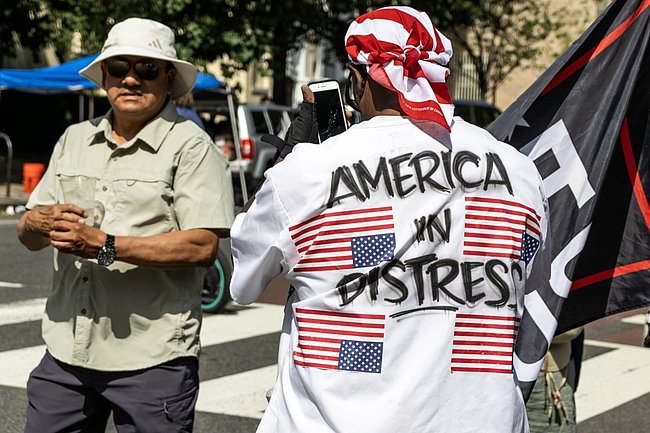
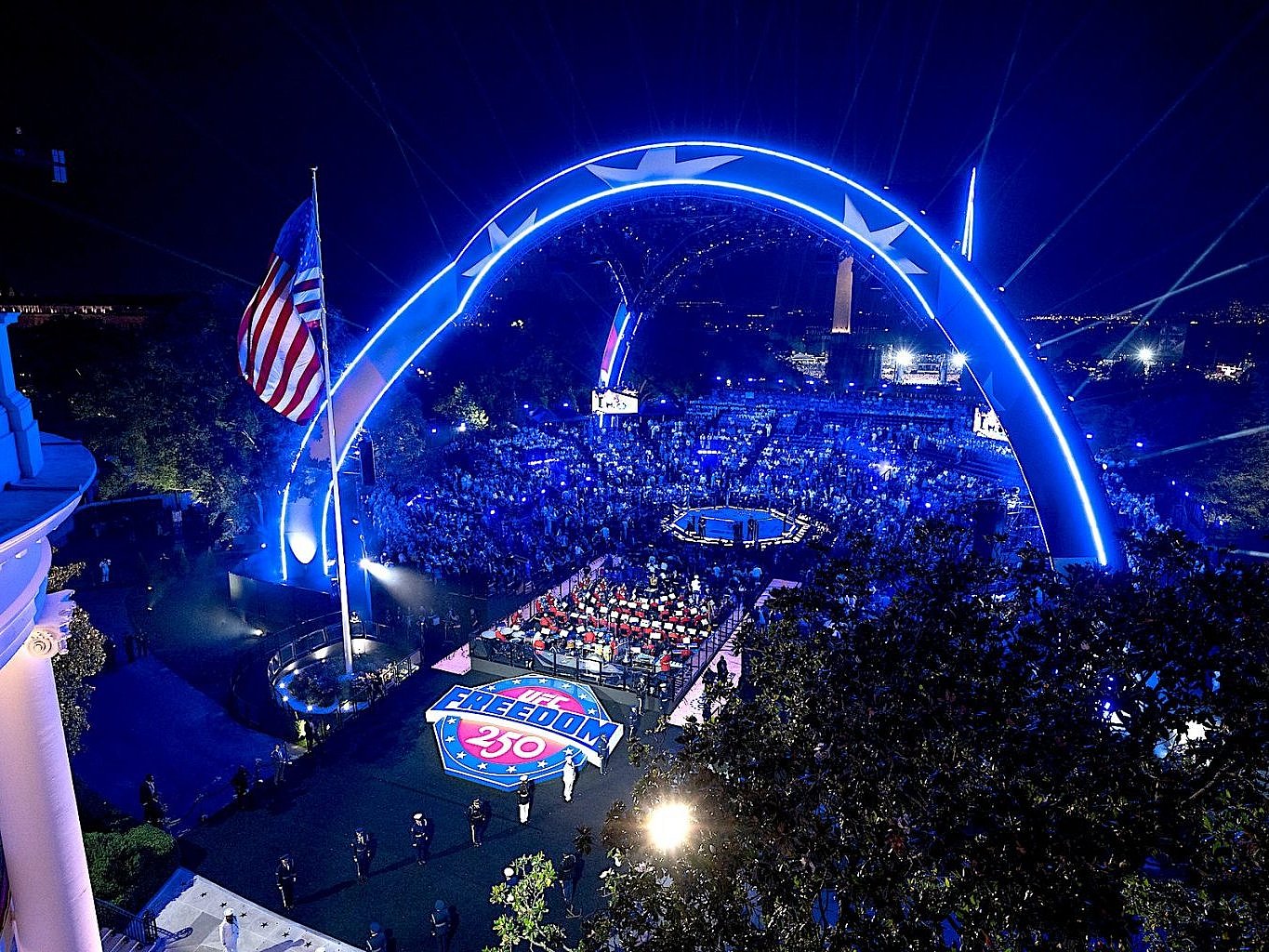
Washington, D.C., street scene during the Ultimate Fighting Championship celebration of both America’s 250th anniversary of Trump’s birthday, June 14.
At writing Democrats are expected to retake control of the lower house of Congress and could — some uncertainty here — win a majority in the Senate. Such an outcome would abruptly open Trump and members of his cabinet to impeachment proceedings. Many Democratic political figures, those administering elections and constitutional lawyers have worried for months what the Trump political machine may do should the polling suggest a reversal of this kind. Will Trump deploy federal troops? Will there be immigration raids near polling places? Will federal agents seize ballots from the states, which the Constitution authorizes to run elections? Will they impound voting equipment? Will Trump’s Justice Department challenge the validity of results?
Bill Bradley, a widely respected Democratic senator over the course of four administrations, from the late 1970s to the late 1990s, reflected these anxieties in an opinion piece published Oct. 27 in The New York Times under the headline, “My Fear for the Midterms”:
“In 2026, we face a new threat: a concerted campaign by the executive branch of the federal government to undermine the midterms. We don’t know if Trump administration officials will follow through on their threats to interfere with the work of election officials, but we must be prepared.”
No, we don’t know at this moment. Americans have been on notice since last spring: The Trump regime and the Republican machine were and probably remain prepared to make the 2026 midterms the most undemocratic in American history. But it is sheer fiction to assert, as Bradley does, that “the American tradition of free and fair elections” is what is at issue. This is a consequential delusion: It keeps voters from facing the above-noted reality, which I count an urgent task.
A couple of things are certain even now, I will conclude.
One, the American polity is too fragile to withstand the mess the Trump regime may cause if it carries through with the sort of threats the president has leveled in recent months. Domestic destabilization (yet worse than what is already evident) and a geopolitical crisis of who knows what magnitude are perfectly plausible. Further, anything like the political chicanery both parties have made a tradition over the course of centuries would devastate what little remains of America’s democratic process.
Two, even before Americans vote and results come in the 2026 midterms stand as a measure of damage this crumbling republic has already sustained. When a nation goes to the polls amid the anxieties to which Bill Bradley gives voice it has lost confidence in itself. It is no longer certain of its Constitution. It is no longer what it once was or thought it was. It and its people can no longer see clearly ahead.
Source: Consortium News.