When France sneezes, it used to be said, all Europe catches cold. One need only consider the French Revolution, 1848’s “Springtime of the Peoples,” or even the student protests of May 1968 to see the point: There is something about France that allows her to act as both catalyst for and barometer of profound shifts in European order.
One wonders whether the riots currently convulsing the Hexagon will prove the latest illustration of this phenomenon. For the past few weeks, malcontents in their tens of thousands have taken to the streets of cities across the country, demanding—something. The demonstrations started with students, who claimed to be opposing poor conditions in schools and problems with the admissions system for higher education. But the schoolkids were soon joined by trade unionists and radicals of all stripes, and the targets of their wrath expanded to encompass fuel prices and the rising cost of living, government budget cuts, a lack of attention to left-wing priorities, and, ultimately, the notion of authority itself.
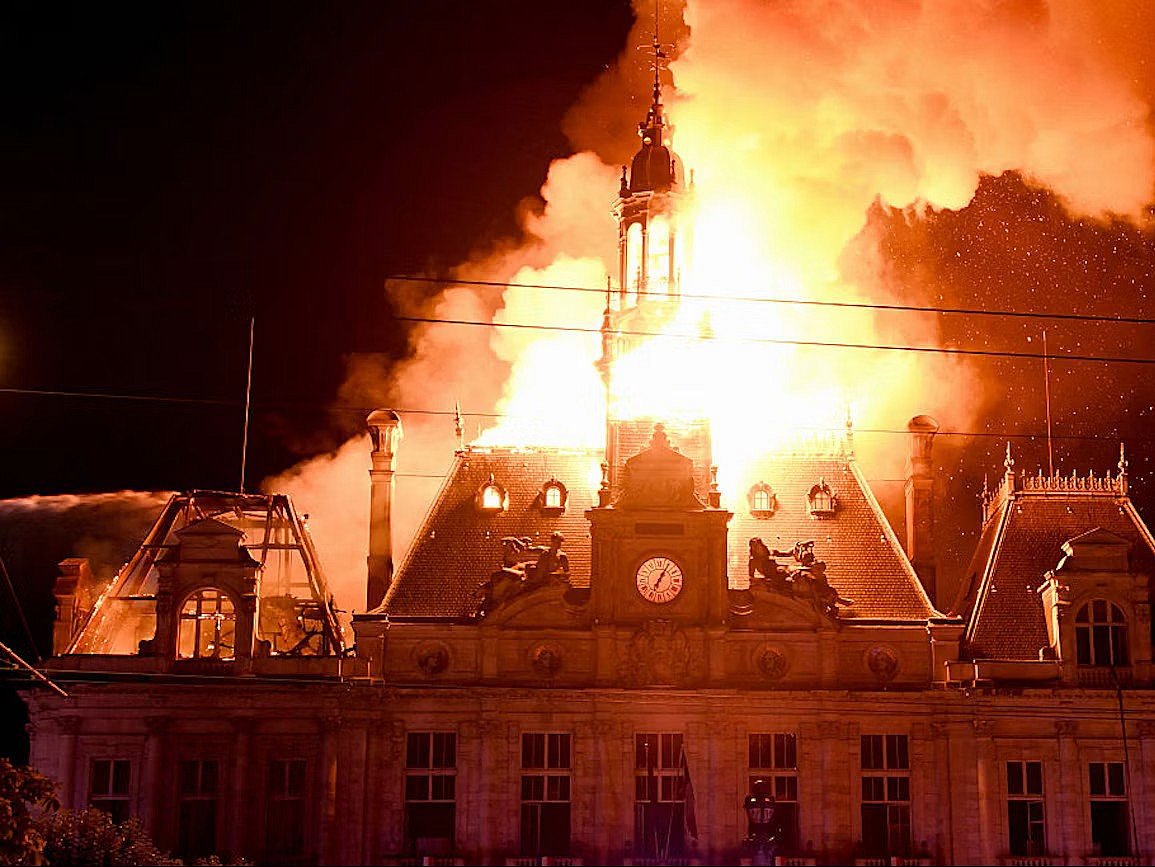
Now protests, in the Gallic tradition, do not tend to display the primness and decorum one might find in a stateside “No Kings” gathering. But this weekend they degenerated into levels of chaos and violence unusual even by French standards. The world was treated to the spectacle of looting, wanton property destruction, and brutal physical assaults across France; nearly 1,000 police officers and gendarmes were injured, and over 2,400 arrests were made between Saturday and Sunday. The degeneracy was perhaps best summed up by an arson attack on the town hall of Limoges, a grand old building that survived two world wars before finally succumbing to the senseless spasms of the mob.
Already, at least a little of the unrest has spread beyond France’s borders. In the past few days, we have seen a few similar demonstrations break out in Madrid, Milan, Lisbon, and Brussels. And there may be good reason to expect further propagation, because the conditions that produced them are common to most European countries.
Consider first the material circumstances. France, like the United States, is in the midst of a cost of living crisis, one that is squeezing ordinary people across the board. But its crisis is more acute and more painful in certain key areas—notably, the oil and gas necessary for commercial transportation, industrial production, and residential heating—and French leaders have far less ability to control the underlying causes (that pesky war in the Mideast, for example).
Moreover, this crisis is unfolding against a backdrop of both anemic economic growth and—critically—looming fiscal crisis. Much has been written about France’s burgeoning public debt and its unconquerable addiction to the financing of extraordinarily lavish benefits via deficit spending. And although the United States is no model of fiscal rectitude, the dollar is hegemonic and we write the rules of the global financial system. France has vastly less cushioning; and the risk of a default has jumped appreciably of late, spooking the government enough for it to actually propose cuts to spending. (Quelle horreur!) The result, of course, is fury and resistance (the protests, at least initially, being an obvious example of this), which tends to paralyze efforts to fix the problem and so worsen the situation.
Then there is the issue of immigration. Whatever the ethnic composition of the rioters and looters—I leave it to the reader to parse the various videos and documentary evidence circulating online—it is clear that mass migration has produced profound and perhaps unbridgeable social fractures. Nearly 12 percent of the French population is foreign-born; of these 8 million or so residents, many lack either the desire or the ability to assimilate into a society that is far less capable of absorbing and integrating newcomers than our own republic. And these excluded millions are, in turn, keenly aware of the uneasiness of their position. The result is a situation of enduring hostility; moments of crisis therefore find large pools of opportunists with little attachment to the existing order and much to gain from its unravelling.
Finally, there is the utter bankruptcy of the political establishment. Emmanuel Macron has been president of France for 10 years and has an approval rating of 15 percent. And although his initial pitch was—as one sage commentator pointed out on X—to forestall the very explosion of popular anger we see occurring today by fixing its underlying causes, it is undeniable that the project of macronisme has failed. It has failed to get France’s economic and fiscal house in order. It has failed to shore up order or meaningfully enhance French power or security. And it has failed to unify the French people. Finally forced to address the nation on Sunday, Macron blamed far-left agitators and “delinquents” for the mayhem, and dutifully promised to both “hear the anger and act on its causes” and “firmly uphold republican order.” (His government also pressed for limited local curfews.) But few of his countrymen seemed to take their president seriously. More compelling was the conclusion of the journalist Vincent Trémolet de Villers:
If the ultra-left, criminals, and looters can turn France upside down in a matter of hours, it is first of all because a technocratic monarchy—intoxicated with its own self-importance—has methodically razed all the moral, security, cultural, and economic safeguards that allow a society to remain standing.
The three failures sketched above may have progressed the furthest in France. But she does not suffer alone. All Europe faces this confluence of severe economic headwinds, mass migration, and an utterly feckless political class.
So, to address the question raised by this article’s heading: Is this it? Is Europe doomed?
The right-wing, anti-establishment parties currently surging in countries like France and Germany offer some prospect of rejuvenation. If things continue to break their way—still a big if—the National Rally, the AfD, and similar forces could replace the current crop of European elites with leaders who grasp both the urgency of the challenge and the necessity of decisive action. But though populists may shore up their political orders and address themselves earnestly to the problem of migration, they are unlikely to find a way out of the continent’s material dilemma. Economic competitiveness will continue to falter, the affordability crisis will probably worsen, and the technologies that will determine future positioning—one thinks especially of AI—may pass Europe by entirely.
And obviously, if the populists fail to take power, Europeans will continue on their current trajectory. The present political establishment is more likely to launch a war with Russia than to get serious about mass migration.
All this suggests pessimism is warranted. Continued decline, though not entirely inevitable, is far more probable than not. Yet, even if these protests continue to spread, the collapse is unlikely to happen all at once, in a sudden conflagration. Rather, it will be a sad drama playing out over years and decades. For if, as Adam Smith famously observed, there is a lot of ruin in a nation, how much more is there in a continent?
Source: The American Conservative.