On 29th of December 2025, The New York Times reprinted an article entitled, “At Last, a Name for the Face of a Nazi in an Iconic Holocaust Photo.”
The photo was taken on July 28, 1941, and here is how the article describes what the picture shows:
“One man kneels at the edge of a pit filled with bodies. He knows that, within moments, he will be dead. His drawn face burns with defiance. Behind him stands a uniformed, bespectacled Nazi soldier. In his extended right arm, the soldier holds a pistol, just inches from his victim’s skull. A crowd of other Germans stand watching, curious but undisturbed.”
The man about to be executed remains nameless and is guilty of nothing other than being Jewish. But who was the executioner? His identity is the revealing part of the story.
“The killer was Jakobus Onnen, 34, a former teacher [he taught languages, French and English as well as physical education] from the town of Tichelwarf, near the German border with the Netherlands.”
His identity was finally matched to other named photos identifying Onnen and attested to by living relatives.
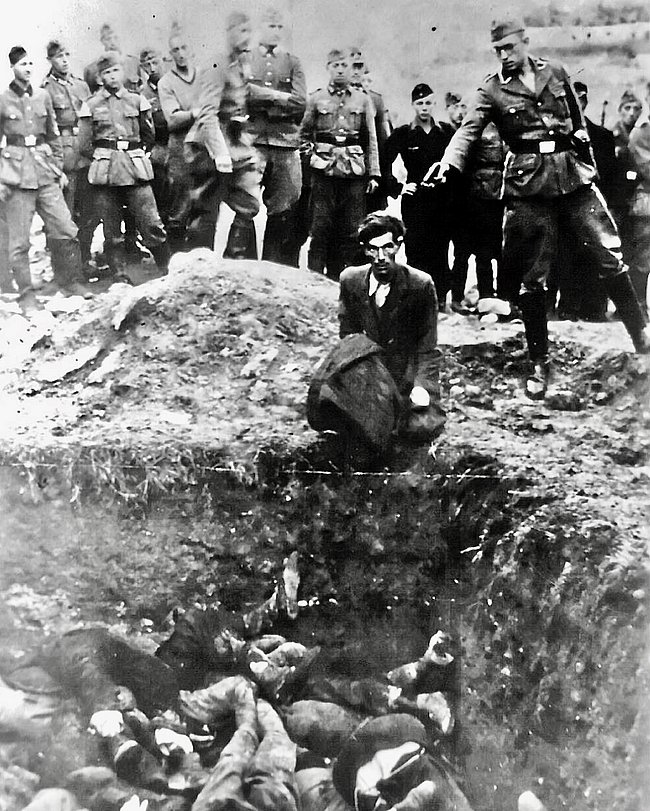
“The Last Jew in Vinnitsa,” depicting the execution of Jews during the Second World War. It shows a Jewish man about to be shot dead by Jakobus Onnen, a member of Einsatzgruppe C, a paramilitary death squad of the Nazi SS, probably near the town of Berdychiv in Ukraine in late July, 1941.
It turns out that Onnen may be seen as an example of “well-educated, prosperous [German] professionals in early middle age” who were transformed into genocidal killers during the era of Nazi influence. How did this occur?
An explanation is offered by Dr. Christopher R. Browning in his 1992 book, Ordinary Men. This is a history of a German reserve police battalion and its role in genocidal violence carried out in 1942 Poland.
Brown argues that most of the men in this battalion did not begin as conscripted Nazi fanatics, rabid antisemites, or congenital killers. Instead they allowed themselves to be remade by “years of propaganda” absorbed within a community environment that “discouraged independent thought”[my italics].
The same environment encouraged “conformity, deference to authority, adaptation to new roles and responsibilities, and the altering of moral norms to justify the resulting actions.” In the end, they “perversely believed [murder] to be a professional obligation.”
How Jakobus Onnen Was Made
Surprisingly, such a transformation is not that difficult to pull off. Every army on the planet attests to the fact that people conscripted to be combat soldiers can be turned into potential willing killers under the right circumstances.
These armies may well have vetting procedures to eliminate sociopaths, but most recruits will be “ordinary men” with no pre-existing mental conditions relevant to their new lethal careers.
Let’s break this down so as to get a better understanding of what the “right circumstances” might be, starting with Jakobus Onnen’s Germany in the 1930s and 40s.
Domestic environment: This designation refers to more than just one’s household, which may or may not be a healthy one. It refers to whether your broader national sphere designates specific enemies.
Jakobus Onnen was the product of years of Nazi inspired antisemitic propaganda. By the time he was 25, he was a member of the Nazi party. He joined the SS at the age of 26. We don’t know how much his home life contributed to his becoming a Nazi, but his community life certainly helped him along.
Obeying authority (following the rules): The Germans have always had a reputation for being rule-following folks. And that rule-following always seemed to have a military undertone. Rule-following is not necessarily the same as respect for the rule of law.
The latter requires a modicum of independent thought leading to an understanding that one’s obedience is not blind. As Christopher Browning suggests, the atmosphere in Germany under Nazi influence discouraged independent thinking.
So, how much personal consideration to his own rule-following did Onnen give? In any case, given the nature of Germany at the time, moving from a community environment into a military environment (getting conscripted) would not have been a traumatic passage for him.
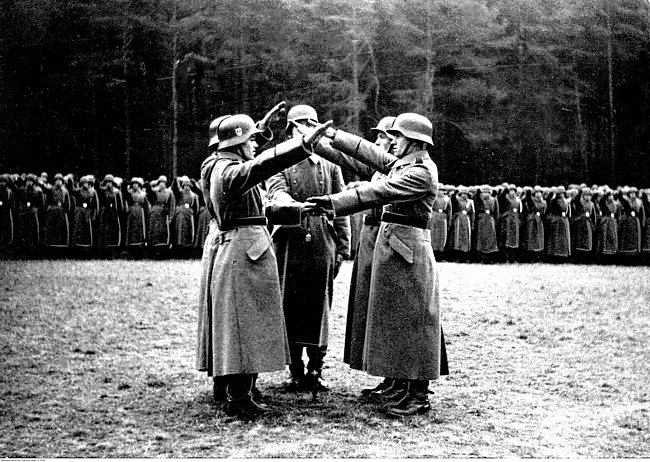
During the swearing-in of the 14th Grenadier Division of the Waffen SS Galizien, soldiers in foreground give the Nazi salute.
Entering a military environment: When one enters military service, voluntarily or otherwise, you put yourself in a rigidly controlled environment. You are always a member of a group where authority is strictly top down.
Obeying orders does not allow for thinking about those orders — even in the highly problematic circumstance that restricts “legal” orders to constitutionally promulgated limits.
Certainly there were no such limitations in the military services of Nazi Germany. If you will, such an environment infantilizes the conscript — he or she is retaught what is “correct” behavior.
In any case, Jakobus Onnen would not have questioned orders from an organization the philosophy and practice of which he readily approved.
Peer pressure: It is not only from the authorities above you that pressure comes to reorient one’s behaviors. Introduced into a rigidly obedient group, it is the group itself that comes to monitor your behavior.
Peer pressure can make many into one and, as Christopher Brown suggests, begins the process of “altering moral norms to justify the resulting actions.” What we have here is not rotten apples spoiling the barrel, but rather a rotten barrel corrupting its contents.
Genocide becomes a possible collective project: The entire process “discourages independent thought.” One gives over thought and judgment to a leader or a party, to an ideology, to a community of ideologues.
Then there is sheer fear. We do not know how many Germans refused to serve once they understood that their country was committing genocide. We do know that in the case of Nazi Germany, one risked one’s life by refusing orders.
Israeli Genocide
Where else, in our own time, can we find an approximation of this scenario — of the “right circumstances” for the creation of men equivalent to Jakobus Onnen? The ironic and sad answer to this question is Israel.
If one simply takes the reality of 78 years of Zionism (a dogma with an overtly racist message) as the ruling ideology in Israel and then plug in the categories listed above, the similarities become clear. So let’s repeat the above exercise.
Domestic environment: Does Israel’s national culture designate specific enemies? Indeed it does. The Zionist Israeli worldview is shaped by decades of anti-Palestinian propaganda.
This has led to a deep-seated racism that segregates and vilifies over 7 million Palestinian subjects. Thus, by the time Israeli Jews are military age they have been taught to see the Palestinians as mortal enemies.
They are portrayed as dangerous and illicit competitors for the land upon which the Israeli state is built. We are left with a “us or them” situation.
Obeying authority (following the rules): Zionist Israel has been shaped into a tight knit community by the history of European Jewish suffering (which Israel sees as part of its own history) and present fear of the Palestinians.
A majority of Israeli Jews, regardless of their level of religious devotion, feel like they are living with an existential threat.
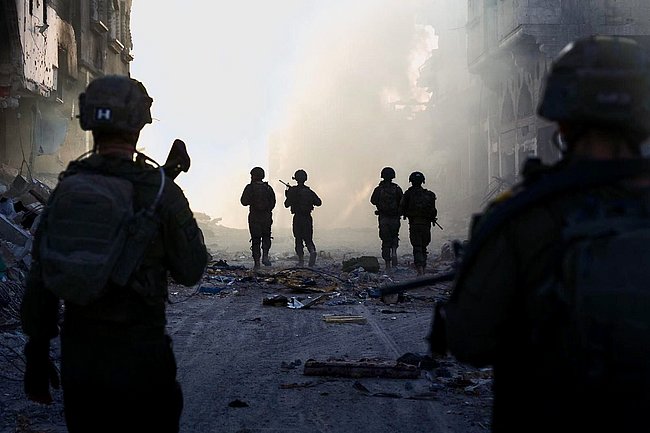
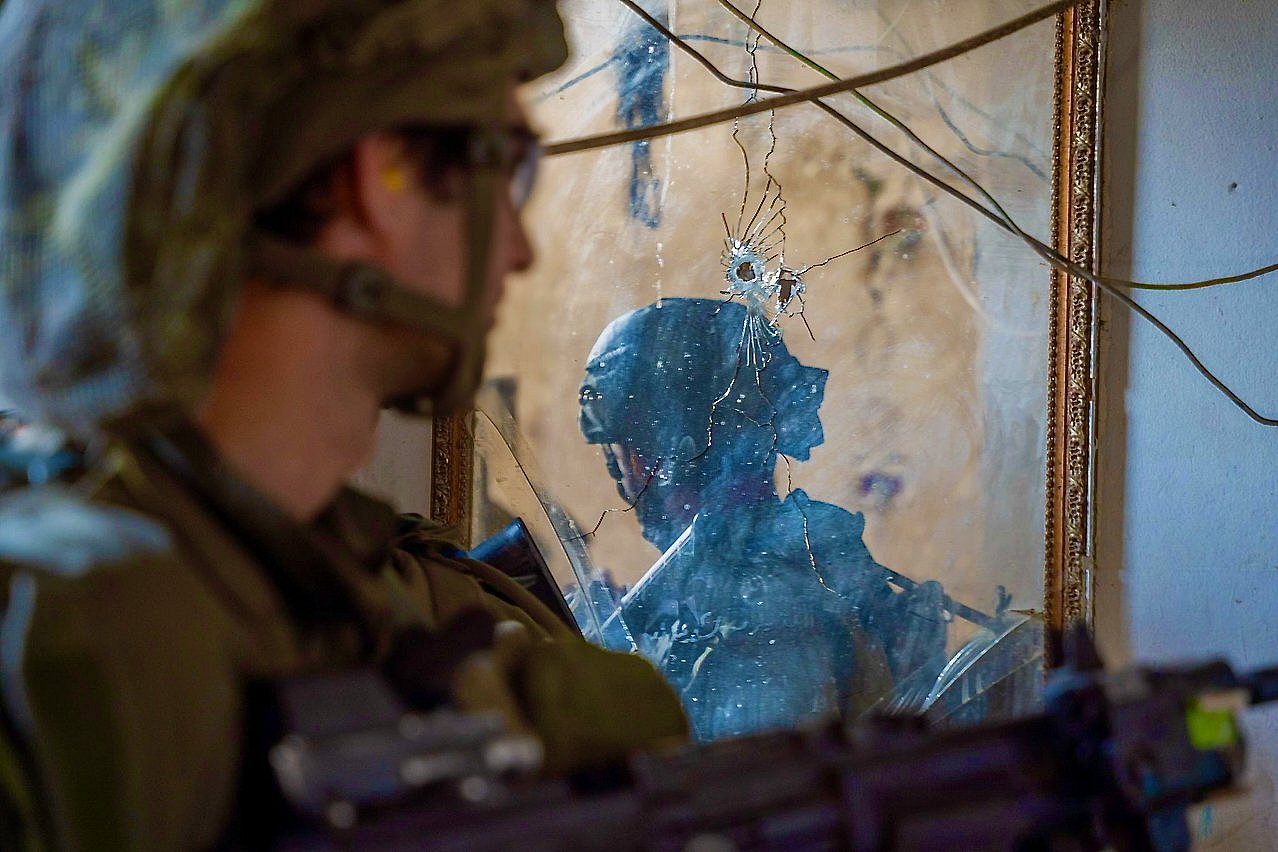
IDF forces in the Gaza Strip on October 20, 2024.
Under the circumstances, following the rules set down by Zionist teachings is seen as a matter of survival. As noted above, rule-following is not necessarily the same as respect for the rule of law.
And, Israel’s resistance to outside rules, such as international norms and laws, is the reverse side of a blind adherence to its idiosyncratic ideology and worldview. How much independent thought about their worldview, and the obedience it demands, have Israeli Jews achieved?
It is telling that those few who do achieve such a perspective are often seen as pariahs.
Entering a military environment: Israel is every bit a militarized society as was Germany in the 1930s.
Again, it bears repeating that obeying military orders does not allow for thinking about those orders. If you will, this environment infantilizes the conscript — he or she is retaught what is correct behavior.
What happens when soldiers are let off the leash, so to speak, of any “rules of engagement?” When there are no limitations? Well, the soldier might well become another Jakobus Onnen.
It would appear there are no present restraints on the behavior of Israeli soldiers operating in Palestinian territory.
Peer pressure: Introduced into this rigidly obedient environment, it is the group itself that comes to monitor one’s behavior. Peer pressure can make many into one and begin the process of “altering moral norms to justify the resulting actions.”
Genocide: Organized genocide now becomes a possible collective project. In Israel’s case, we do know that a growing number of reserve soldiers who have served in the genocidal Gaza war are seeking to avoid repeated terms of service.
We do not know how many of these soldiers are doing so for ethical reasons. There is also the fact that more than 150,000 Israelis have left the country in the past two years.
Perhaps out of dislike for the recent right wing turn in government, or for economic reasons, rather than ethical disgust.
Conclusion
What do we have here? Perhaps, given Israel’s thoroughly internalized history of Europe’s Jews, we are witnessing a nationwide expression of a battered child syndrome. But such a syndrome does not produce what Hanin Majadli, writing in the Israeli paper Haaretz (9 January 2026), calls a “thriving genocidal consciousness.”
Rather, she tells us that the Israeli genocide in Gaza is the product of long building “trends … political and social brutalization, the institutionalization of fascism and the systematic erosion of restraint, respectful language and the boundaries of what’s permitted and forbidden. Cruelty, violence and revenge stopped being seen as a deviation and became … legitimate options.”
This is today’s Israel.
The process of cultural corruption is not exactly the same as that of interwar Germany under Nazi influence but, as we have seen, there is enough of an overlap. And, the abdication of individual thought to an aggressive ideology is particularly similar, as are some of the horrible consequences.
Such an approximate comparison has been noted before.
In 1992, in Israel, a televised debate took place between Yeshayahu Leibowitz (1903-1994), perhaps the greatest Israeli social critic of his day, and the Israeli politician Tommy Lapid, (1931-2008) himself a Holocaust survivor.
Leibowitz, who had earlier coined the term ‘Judeo Nazi’ to refer to the ethical deterioration of a growing number of Israelis, was challenged by Lapid.
He asks Leibowitz, “are we burning them [the Palestinians]? Are we putting them in gas chambers?” Leibowitz pauses to think before answering him, and then says, “that is your prophecy.”
Today, there are no gas chambers in Gaza, yet the prophecy assigned to Lapid has come true utilizing different means: blitzkrieg, massive indiscriminate death, and a majority of the Israeli Jewish population which is coldly indifferent to the horrors they have wrought.
Finally, if Israeli Jews can be reshaped into genocidal killers, so can other peoples.
All one needs is an environment that designates specific enemies, encourages abdication of independent thought to ideological thinking (particularly of the racist variety), weakens behavioral restraints, and you’re on the road that can take you to mass murder and genocide.
Source: Consortium News.