As we read revelations of the sordid, bottomlessly rank doings of Jeffrey Epstein and the vast circle of elites with whom he managed to surround himself—and god knows how immense the inventory of “redacted” material, how many the names and crimes that will never come to light—we read of the collapse of our world, nothing less. Our world: the Western world, the Atlantic world, the world wherein humanity began, in the eighteenth century, to bring modern democracies and republics into being.
Yes, much has been written over many years of the decline of the West. We have remarked upon this countless times in these pages. But we are confronted now with more, far more, than questions of national power, shifting geopolitics, the rise to prominence of the non–West, and the new world order these nations, their turn now come, are intent on bringing into being.
Questions of power and politics figure prominently in the Epstein affair, certainly. But even the partial release of the Epstein files takes us well beyond such matters, large as they are. As the rock is lifted, we find beneath it the rot of our foundational institutions and the beyond-belief nihilism of those who control them—altogether the worms that have eaten into any semblance of order, law, or justice to which the West’s democracies and republics may once have had a purchase.

Sign demanding release of Epstein files at No Kings Protest, Mass., Oct. 18, 2025.
Toynbee warned of this in A Study of History, the 12 volumes of which he produced from 1934 to 1961. Civilizations decline and fall, he asserted in his most famous thesis, not primarily due to external forces but in consequence of internal decadence and lapses of spirit among societal elites.
What had served as “creative minorities” devolve into “dominant minorities” that no longer believe even in themselves. They then take to glorifying what elites once were but are no longer. Toynbee is out of fashion now, but I find in the books a mirror of our circumstance as we have them all these years later.
Meaning, truth, reason, language, purpose, social relations of all kinds: What is left of these in this, our post–Epstein era? Tomorrow will give the appearance of today and yesterday, but no, Toto, we are very far from Kansas now. And the point to be grasped as we manage the shock of the Epstein revelations is that there is no longer any going back to Kansas. Kansas is gone.
As others have remarked in recent days, for Americans, and by extension all those who have thought of themselves as citizens elsewhere in the West, there is nowhere else to turn now but to themselves.
“A Republic, If You Can Keep It.”
On Sept. 17, 1787, a prominent Philadelphia salonnière named Elizabeth Willing Powel put a blunt question to Benjamin Franklin. The Constitutional Convention drew to a close that day, its business complete; Franklin was 81 and infirm. “Well, Doctor, what have we got, a republic or a monarchy?” Willing Powel asked.
“A republic, if you can keep it,” was Franklin’s famous reply.
We have failed to keep it: This is the truth of our moment. Now what? This is the question of our moment.
“There has always been a privileged class, even in America, but it has never been so dangerously isolated from its surroundings,” Christopher Lasch wrote as he began The Revolt of the Elites and the Betrayal of Democracy (Norton, 1995). It was the great social historian’s last book, published posthumously. I wonder if Lasch, prescient as he often was, could have imagined the dangers with which these elites have since come to confront us.
A refusal to accept limits of any kind, the abandonment of all notions of moral conduct, indifference to all others not of their status, the rejection of any of the responsibilities attaching to positions of influence and power: These manifest now as grave dangers across the Western post-democracies.
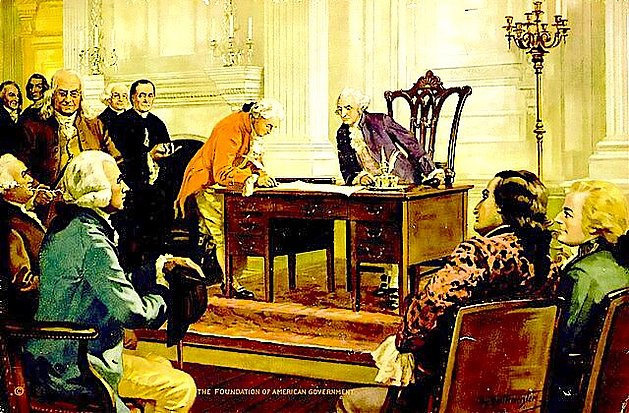
The Foundation of the American Government, signing of the Constitution.
As Lasch wrote in the just-noted book, the elites of the past understood that their places in society imposed upon them “civic obligations”—Lasch’s term. There were social contracts, in plain language. With privileges came duties, and a certain pride was taken in fulfilling these duties.
Hold Epstein and those around him up to this light and you instantly recognize a fundamental change of ethos among the elites of our time: Arrogance has replaced any such pride. This, too, we can count a danger.
How do we account for the depravity to which the West’s elites have sunk—their endless derelictions, their celebrations of a shared narcissism, the strange absence of any kind of order within the bubbles, the many-gated cities, inside of which they live and move?
“Indifference to all others not of their status, the rejection of any of the responsibilities attaching to positions of influence and power: These manifest now as grave dangers across the Western post-democracies.”
Who are these people? Who? The question leads us into a history we might call psycho-social, and it is well we understand it.
We must go back to Emmanuel Kant to address our present properly. It was Kant who emerged among the great apostles of the Enlightenment, a.k.a. the Age of Reason, during the 1780s, when he wrote the books for which he is best known. In 1784 he published a brief essay—it prints out today at seven pages—called “What Is Enlightenment?”
Kant’s answer turned on the liberation of the individual. It was the free-standing individual, capable of discerning, reasoning, and judging for himself or herself without reference to the coercive relations of the past, who would announce the enlightenment of humanity from the reigning state of “immaturity,” as Kant called it.
From the opening lines of this famous essay:
“Enlightenment is man’s emergence from his self-imposed immaturity. Immaturity is the inability to use one’s understanding without guidance from another.”
A few paragraphs in, Kant wrote aspirationally of “a few who, after having themselves thrown off the yoke of immaturity, will spread the spirit of a rational appreciation for both their own worth and for each person’s calling to think for himself.”
Stirring, of course. And how thoroughly has this accolade to individuality permeated Western culture from Kant’s day until ours.
Monsters of Boundless Subjectivity
But over time this idealization of the individual produced—and I am not first to use this term—a monster. Who could possibly have anticipated this as the outcome of so salutary a breakthrough in the human consciousness? Let us call it the monster of boundless subjectivity.
The thinking-for-himself individual—discerning, reasoning, judging—came subliminally to conclude that he or she was capable of discerning, reasoning through and judging any event, circumstance, course of action, or phenomenon and getting it right without reference to the learning, knowledge, or expertise of anyone else. An ethos of all-knowingness, made of sheer presumption, came to prevail.
What had long served as external sources of order and guides to conduct were in one or another way discredited. Morality—essential point here—was internalized. Even law, which is by definition an altogether public agreement among those in a given polity, was internalized.
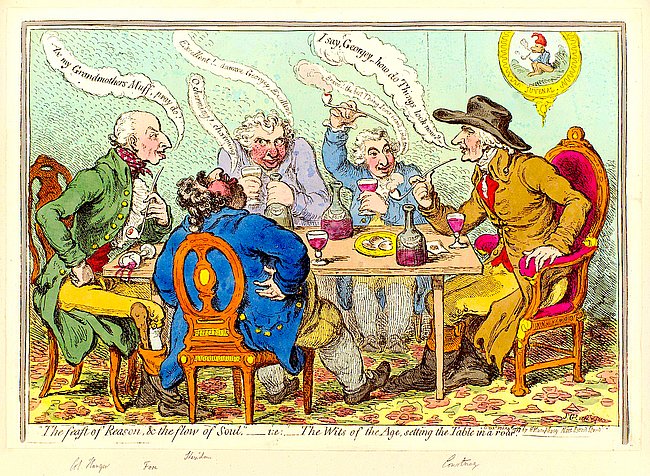
The feast of reason, and the flow of soul,’ – ie – the wits of the age, setting the table in a roar.
There is no walking around anywhere in the Western world without encountering a person of these subconscious convictions. He is not well-read but thinks he is well- read, not well-informed but certain he is. He has an opinion about everything and it is a worthy opinion because it is his opinion. He is, borrowing and bending a phrase from John Ralston Saul, one of Kant’s bastards.
It is but a few short steps to the more diabolic presumption, and this, too, is essential to our grasp of power and how it is exercised in our time: If I think something is right for me it is altogether right because I think it is right. In this way the Age of Reason Kant celebrated has given way—a gradual process, Jeffrey Epstein merely a thoroughly unconscious exemplar—to an Age of Unreason, as I call our time. I dilated on this topic in a lecture delivered in Switzerland last summer. I subsequently published it in Consortium News, and it is here.
The elites described in the Epstein files, such as we have them, are best understood as people of this kind. They are among Kant’s bastards, extreme as their case may be. And we know by now that President Trump, via the thousands of mentions of his name in the documents, is through and through one of Kant’s bastards. This is not a matter of whether Trump dropped his drawers with one of Epstein’s underage victims: It is a question of his consciousness.
In early January four Washington correspondents from The New York Times conducted a lengthy interview with Donald Trump. During it they asked the president whether there were any limits on his exercise of power in the global context. The coup in Venezuela was but a few days previous.
“Yeah, there is one thing,” Trump replied. “My own morality. My own mind. It’s the only thing that can stop me.” As if this were not enough he added, “I don’t need international law.”
“This is not a matter of whether Trump dropped his drawers with one of Epstein’s underage victims: It is a question of his consciousness.”
The Times’s report then continued:
“‘When pressed further about whether his administration needed to abide by international law, Mr. Trump said, ‘I do.’ But he made clear he would be the arbiter when such constraints applied to the United States. ‘It depends what your definition of international law is,'” he said.”
This is well beyond the narcissism commonly ascribed to Donald Trump. It tilts to sheer solipsism.
James Marriott, one of the only interesting voices in the Times of London’s otherwise dull opinion section, published “Jeffrey Epstein circle’s ‘big ideas’ were vacuous guff.” It goes straight to my earlier point: The monster of boundless subjectivity is ever to be found among Kant’s bastards, empty minds ever to be dressed up as high intellects.

Maison de L’Amitie mansion in Palm Beach, Florida, bought by Donald Trump in 2004 after winning a Trump-Epstein bidding war.
Marriott writes in part:
“Contemplating their ranches, private islands and jets, the Epstein set managed to convince themselves that all this wealth was not evidence of anything as prosaic as birth or luck or hard work—rather, these were the rewards of intellect, ‘superforecasting’ and “pattern reading.” …
The men in Epstein’s circle continually congratulate one another on their intelligence: ‘U r wall st tough guy w intellectual curiosity,’ Larry Summers told Epstein.
‘And you an intellectual with a Wall Street curiosity,’ Epstein replied…. Prince Andrew was still at this when he told Emily Maitlis that he didn’t regret his friendship with Epstein because of ‘the opportunities that I was given to learn either by him or because of him.’
Did it occur to nobody in this world that when Andrew is praising you as an intellectual something has gone horribly wrong?
Never in history has so much money surrounded itself with so much pseudo-intellectual guff. Gusts of it drift annually through Davos with its seminars on the power of dialogue and the meaning of tipping points.
The spirit is institutionalised in the large companies which, no longer content with merely making money, adopt ‘corporate philosophies.’ It is all-pervading in the tech industry, with its pseud0 meditations on consciousness. Sam Altman boasts that he ‘consulted, like, hundreds of moral philosophers’ when developing ChatGPT.”
I quote this passage at length because Marriott reminds us in it that the delusions and corruptions evident within Epstein’s circle are not confined to it. No, they are typical, if less sordid, of power elites across the Western post-democracies—in politics, judiciaries, finance, the universities, corporate media.
And I have to add: We will be reminded of this once again, bitterly, as it becomes evident that few of those implicated in the Epstein scene—if anyone, indeed—will be charged, tried, sentenced, or otherwise held to account for crimes that in some cases seem to verge on the unspeakable.
On the same day Marriott’s piece appeared, Alastair Crooke published another in Strategic Culture and, subsequently, Eurasiareview under the headline, “The Slow Epstein Earthquake: The Rupture Between the People and the Elites.” Crooke, going straight to this last point, begins just where we all must:
“After Epstein, nothing can continue as before: Neither the post war ‘never again’ values—reflecting sentiment at the end of bloody wars—and the widespread yearning for a ‘fairer’ society; nor the bipolar economics of extreme disparities in wealth; nor trust—after the exposed venality, rotted institutions and perversions that the Epstein files have shown to be endemic amongst certain of the western élites.
How to speak of ‘values’ against this background?”
Crooke addresses how the Epstein affair looks to young people—but not to the exclusion of the rest of us—as he concludes with his reflections on the world that has so spectacularly collapsed all around us:
“If protest has no effect in changing the status quo, and elections remain between the Tweedle Dee and Dum parties of the existing order, the young will conclude that ‘no one will come to save us’—and they may conclude in their despair that the future can only be decided on the streets.”
I don’t see why, Alastair, this judgment is the purview of the young alone. It is there for anyone paying attention to make. History, including America’s, is replete with examples of how the street figures when let-them-eat-cake elites prove as indifferent to the commonweal as those who now hold power.
Source: Consortium News.