What constitutes national security and how is it best achieved? Does massive military spending really make a country more secure, and what perils to democracy and liberty are posed by vast military establishments?
Questions like those are rarely addressed in honest ways in America. Instead, the Trump administration favors preparations for war and more war, fueled by potentially enormous increases in military spending that are dishonestly framed as “recapitalizations” of America’s security and safety.
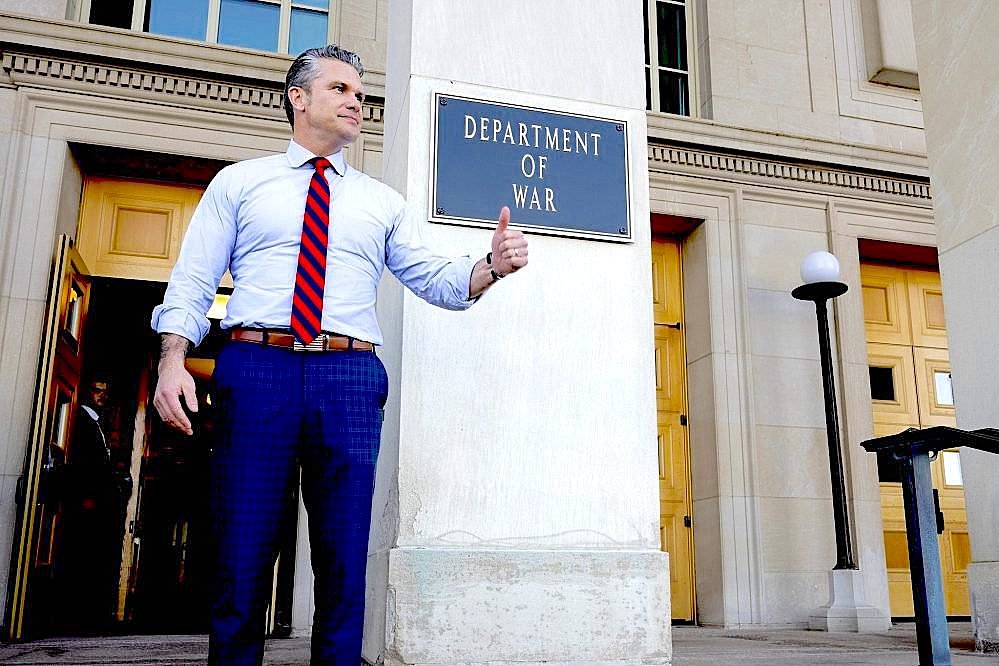
Such framing makes Pete Hegseth, America’s self-styled “secretary of war,” seem almost refreshingly honest in his embrace of a warrior ethos. Republican Senator Lindsey Graham is another “warrior” who cheers for conflict, whether with Venezuela, Iran, or even — yes! — Russia. Such macho men revel in what they believe is this country’s divine mission to dominate the world.
Tragically, at the moment, unapologetic warmongers like Hegseth and Graham are winning the political and cultural battle.
Of course, U.S. warmongering is anything but new. Neither is a belief in global dominance through high military spending.
In 1983, as a college student, I worked on a project that critiqued President Ronald Reagan’s “defense” buildup and his embrace of pie-in-the-sky concepts like the Strategic Defense Initiative (S.D.I)., better known as “Star Wars.”
Never did I imagine that, more than 40 years later, another Republican president would again come to embrace S.D.I. (rebranded “Golden Dome”) and ever-more massive military spending, especially since the Soviet Union, America’s superpower rival in Reagan’s time, ceased to exist 35 years ago.
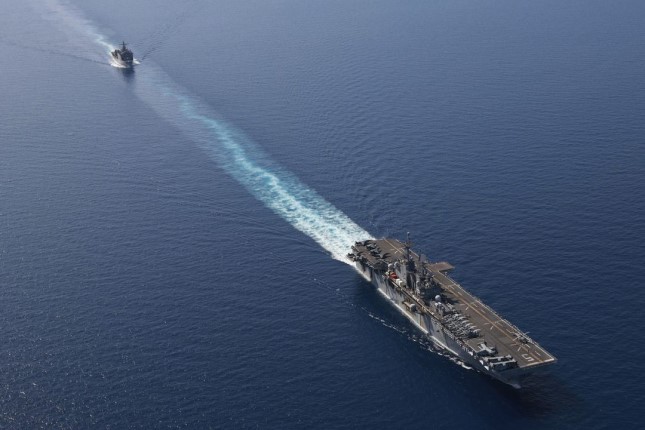
Amazingly, Trump even wants to bring back naval battleships, as Reagan briefly did (though he didn’t have the temerity to call for a new class of ships to be named after himself). It’ll be a “golden fleet,” says Trump.
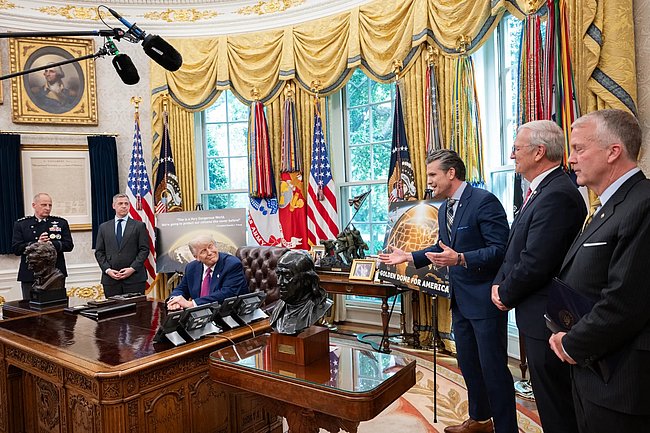
President Trump announces the Golden Dome missile defense system, May 2025.
Trump’s recent advocacy of a “dream military” with a proposed budget of $1.5 trillion in 2027 (half a trillion dollars larger than the present Pentagon budget), is a proposal disturbingly backed by the editorial board of The Washington Post.
But at the Pentagon, nothing succeeds like failure, namely eight failed audits in a row (part of a 30-year pattern of financial finagling) that accompanied disastrous wars in Vietnam, Afghanistan, Iraq, and elsewhere.
Reagan was nicknamed the “Teflon president” because scandals didn’t seem to stick to him (at least until the Iran-Contra affair proved tough to shed). Yet history’s best candidate for Teflon “no-stick” status was never Reagan or any other president. It was and remains the U.S. warfare state itself, headquartered on the Potomac River in Washington. Even as the Pentagon has moved from failure to failure in war-fighting, its war budgets have continued to soar and soar some more.
The Democrats, supposedly the “resistance” to Trump, boast openly of their support for what passes for military lethality (or at least overpriced weaponry), while Democratic members of Congress line up for their share of war-driven pork. To cite a cri de coeur from the 1950s, have they no sense of decency?
The Shameless Embrace of Forever War & Its Spoils
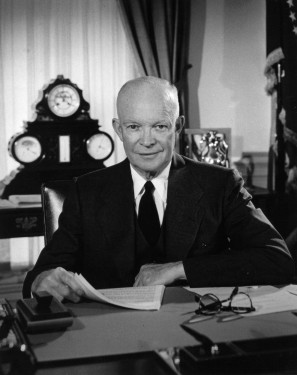
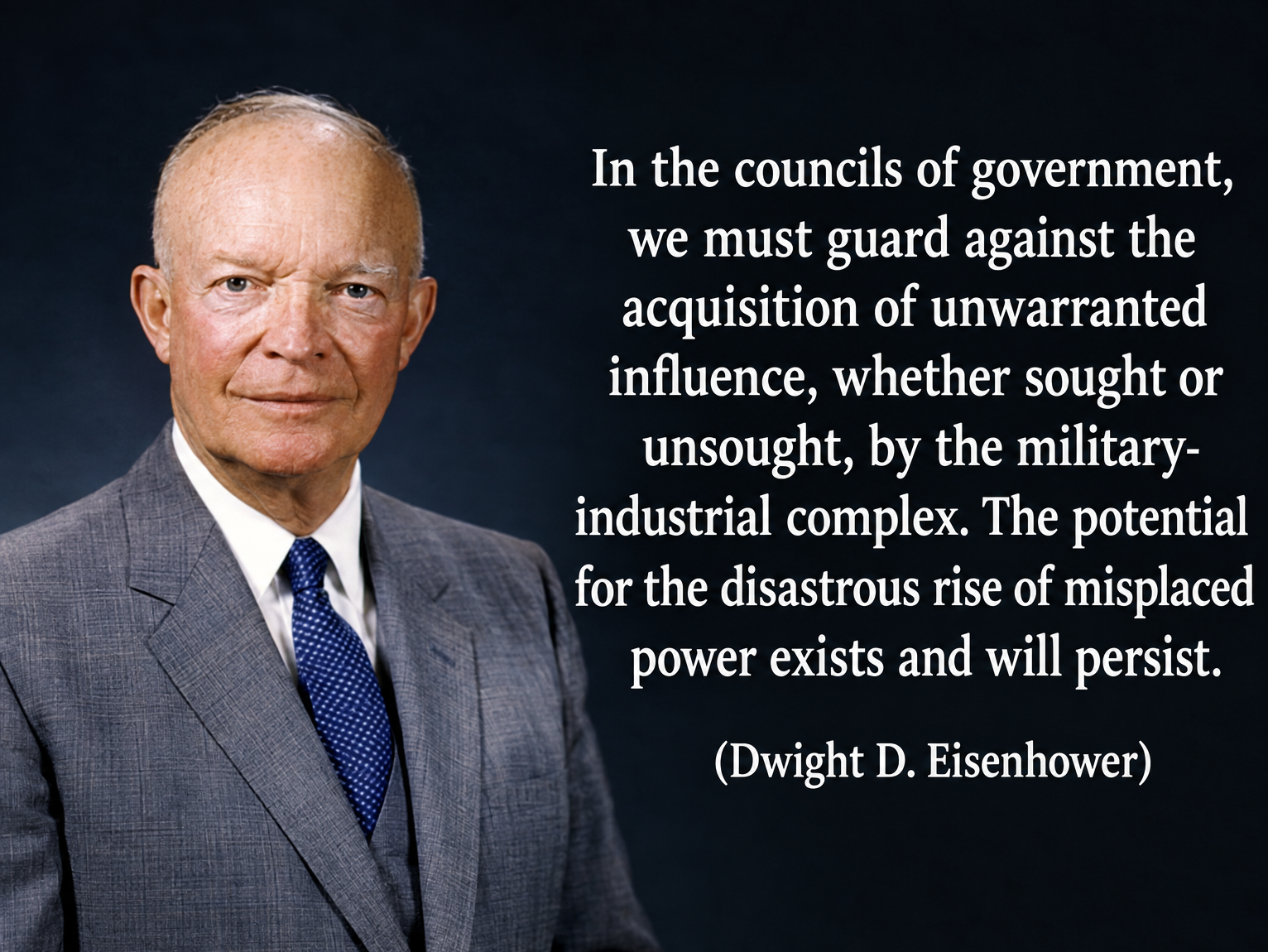
In his farewell address, President Dwight D. Eisenhower famously warned U.S. citizens about the “military–industrial complex.”
America should still embrace the words of Dwight D. Eisenhower, the first significant figure to warn the country about the then-developing military-industrial complex (MIC) in his 1961 farewell address to the nation. Yet, even then, his words were largely ignored. Recently, I reread Ike’s warning, perhaps for the 100th time and was struck yet again by the way he highlighted the spiritual dimension of the challenge that all too sadly still remains.
Ike ’said:
“This conjunction of an immense military establishment and a large arms industry is new in the American experience. The total influence — economic, political, even spiritual — is felt in every city, every state house, every office of the Federal government. We recognize the imperative need for this development. Yet we must not fail to comprehend its grave implications. Our toil, resources, and livelihood are all involved; so is the very structure of our society.
In the councils of government, we must guard against the acquisition of unwarranted influence, whether sought or unsought, by the military-industrial complex. The potential for the disastrous rise of misplaced power exists and will persist.
We must never let the weight of this combination endanger our liberties or democratic processes. We should take nothing for granted. Only an alert and knowledgeable citizenry can compel the proper meshing of the huge industrial and military machinery of defense with our peaceful methods and goals, so that security and liberty may prosper together.”
Those were the prescient words of the most senior military man of his era, a citizen-soldier and president, and more than six decades later, they need to be acted on if there is to be any hope left of preserving “our liberties and democratic processes.”
Wise words seldom heeded. Since 1961, the MIC’s “disastrous rise of misplaced power” has infected U.S economy and culture. Indeed, though the MIC failed spectacularly to win the hearts and minds of the Vietnamese, the Afghans, the Iraqis, plus other embattled peoples across the globe in misbegotten and mendacious wars, it did succeed, over the years, in winning the hearts and minds of those who make the decisions in the U.S. government.
In an astonishing paradox, a spendthrift military establishment that almost never wins anything, while consistently evading accountability for its losses, has by now captured almost untrammeled authority within the land.
It defies logic, but logic never was this country’s strong suit. We reached a point of almost ultimate illogic when America’s bully-boy commander-in-chief insisted that an already bloated Pentagon budget needs an extra $500 billion, bringing it to about $1.5 trillion annually.
No matter what it does, the Pentagon, America’s prodigal son, never gets punished. It simply gets more.
More, More, More!
Not only is such colossal military spending bad for the country, but it’s also bad for the military itself. After all, it didn’t ask for Trump’s proposed $500 billion raise. America’s prodigal son was relatively content with a trillion dollars in yearly spending. In fact, the president’s suggested increase in the Pentagon budget isn’t just reckless; it may well wreck not just what’s left of democracy, but the military, too.
Like any massive institution, the Pentagon always wants more: more troops, more weapons, more power, invariably justified by inflating (or simply creating) threats to this country. Yet, clarity of thought, not to speak of creativity, rarely derives from excess. Lean times make for better thinking, fat times make for little thought at all.
Not long ago, Trump occasionally talked sense by railing on the campaign trail against the military-industrial complex and its endless wars. Certainly, more than a few Americans voted for him in 2024 because they believed he truly did want to focus on domestic health and strength rather than pursue yet more conflicts globally (and the weapons systems that went with them).
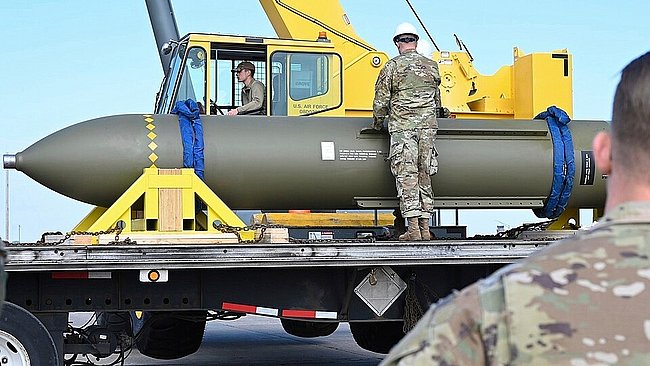
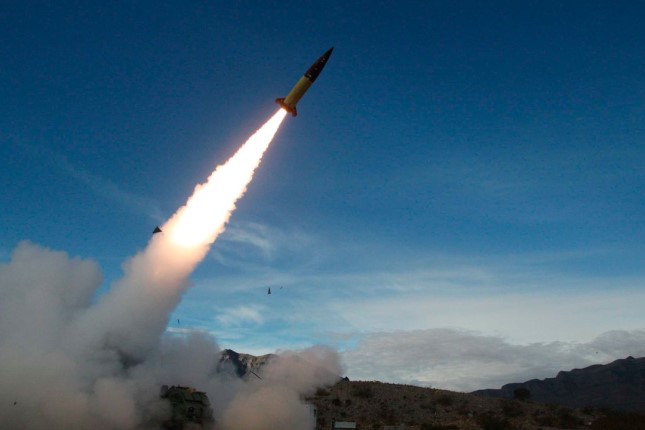
Operation Midnight Hammer against Iran, June 2025, was the first combat use of the 30,000-pound GBU-57 MOP
Tragically, Trump has morphed into a warlord, greedily siphoning oil from Venezuela, posturing for the annexation of Greenland and its resources, while not hesitating to bomb Iran, Nigeria, or most any other country.
Although Trump’s supporters may indeed have been conned into imagining him as a prince of peace, the country’s militarism and imperialism clearly transcend him.
Generally speaking, warfare and military boosterism have been distinctly bipartisan pursuits in America, making reform of any sort that much more difficult. Replacing Trump in 2028 won’t magically erase deep-rooted militarism, megalomaniacal imperial designs, or even the possibility of a $1.5 trillion military budget.
Clearly, more, more, more is the bipartisan war song sung inside the Pentagon, Congress, and the White House.
Taking on the MICIMATTSHG, or the Blob
Ex-CIA analyst Ray McGovern coined a useful acronym from the classic military-industrial complex, or MIC. He came up with MICIMATT (the Military-Industrial-Congressional-Intelligence-Media-Academia-Think-Tank complex) to highlight its blob-like growth. Congress and the rest are all deeply implicated in the blob.
I would add an “S” for the sporting world, an “H” for Hollywood, and a “G” for the gaming sector, which influence the public while being influenced by and subservient to the MIC. That gives us MICIMATTSHG.
Ike warned about the “disastrous rise of misplaced power” if it wasn’t challenged back in 1961. He also warned that the MIC could change the very structure of society, making America far less democratic. Subtly, he warned it might weaken America spiritually.
What did he mean by that? In another speech Ike made in 1953, he warned that Americans could end up hanging themselves from a cross of iron, becoming captives of war by pursuing military dominance globally, while losing democratic beliefs and liberties at home.
That is exactly what happened. The people were seduced, silenced, or sidelined via slogans like “support our troops” or with over-the-top patriotic displays like military parades, no matter that they represented something distinctly less than triumphant.
Americans in various polls today indicate that they don’t want a war against either Venezuela or Iran, but their opinions simply aren’t heeded. It’s time to perform an “about-face” and a march in double-time away from permanent war.
That means major reductions in Pentagon spending. The best and only way to tackle the inexorable growth of the blob is to stop feeding it money — and stop worshipping it. Instead of a $500 billion increase, Congress should insist on a $500 billion decrease in Pentagon spending. The task should be to force the military-industrial complex to think, improvise, become leaner and focus on how most effectively to defend America rather than fostering imperial dreams of wannabe warlords.
Trump’s current approach of further engorging the imperial blob is the stuff of national nightmares, not faintly a recipe for American greatness. It is, in fact, a sure guarantee of further decline and eventual collapse, not only economically and politically but spiritually as Ike warned in 1961. More wars and weapons will not make America great (again).
As the U.S. celebrates its 250th birthday on July 4, 2026, wouldn’t it be wonderful if it could save this deeply disturbed country by putting war and empire firmly in the rearview mirror? A tall task for sure, but so, too, was declaring independence from the British Empire in 1776.
Source: Consortium News.