The Russian Foreign Ministry said in a statement that it believes the U.S. and Russia are no longer bound by New START, the last remaining nuclear arms control treaty between the two powers, which is expiring today.
“In the current circumstances, we assume that the Parties to the New START are no longer bound by any obligations or symmetrical declarations in the context of the Treaty, including its core provisions, and are in principle free to choose their next steps,” the ministry said in a statement issued on Telegram on Wednesday, the day before the treaty officially expires.
The New START treaty caps the number of nuclear warheads each side can deploy at 1,550 and limits the number of deployed and non-deployed strategic launchers to 800.
The Russian ministry’s statement noted that President Vladimir Putin had offered a mutual agreement to maintain those limits for another year to make room for diplomacy to negotiate a new treaty, but the Trump administration hasn’t responded to the proposal.
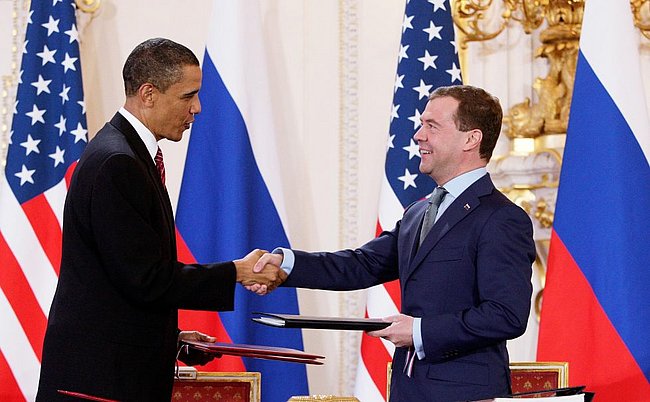
Barack Obama and Dmitry Medvedev after signing New START treaty, Prague, April 8, 2010
“However, no formal official response from the United States with regard to the Russian initiative has been received through bilateral channels… It means that our ideas have been deliberately left unanswered,” the ministry said.
[Axios reports Russia and U.S. work on deal to continue observing treaty.]
Former Russian President Dmitry Medvedev, who signed the New START with then-US President Barack Obama in 2010, mentioned the end of the treaty on X. “That’s it. For the first time since 1972, Russia (the former USSR) and the US have no treaty limiting strategic nuclear forces. SALT 1, SALT 2, START I, START II, SORT, New START – all in the past,” he said in a post that included a meme that said “winter is coming.”
Secretary of State Marco Rubio was asked about the treaty’s expiration on Wednesday and said that any arms control must include China, but Beijing has maintained it won’t enter into a trilateral deal unless Washington and Moscow reduce their nuclear stockpile, since China has significantly fewer nuclear weapons.
“China’s position on a trilateral negotiation with the U.S. and Russia on nuclear arms control is clear,” Chinese Foreign Ministry spokesman Lin Jian told reporters on Tuesday. “China’s nuclear strength is by no means at the same level with that of the US It is neither fair nor reasonable to ask China to join the nuclear disarmament negotiations at this stage.”
Arms control experts have warned that the expiration of the treaty without a replacement or an agreement on maintaining its limits will likely lead to an increase in the deployment of nuclear weapons and spark a new arms race.
Polling shows that American voters overwhelmingly support the idea of Trump accepting Putin’s offer to maintain the New START limits and want the US and Russia to negotiate a new deal that either maintains those restrictions or results in a reduction of nuclear weapons.
By Brett Wilkins
U.S. Secretary of State Marco Rubio has confirmed that New START — a key arms control treaty between the United States and Russia — expired today, prompting demands for “a more coherent approach from the Trump administration” toward nuclear nonproliferation.
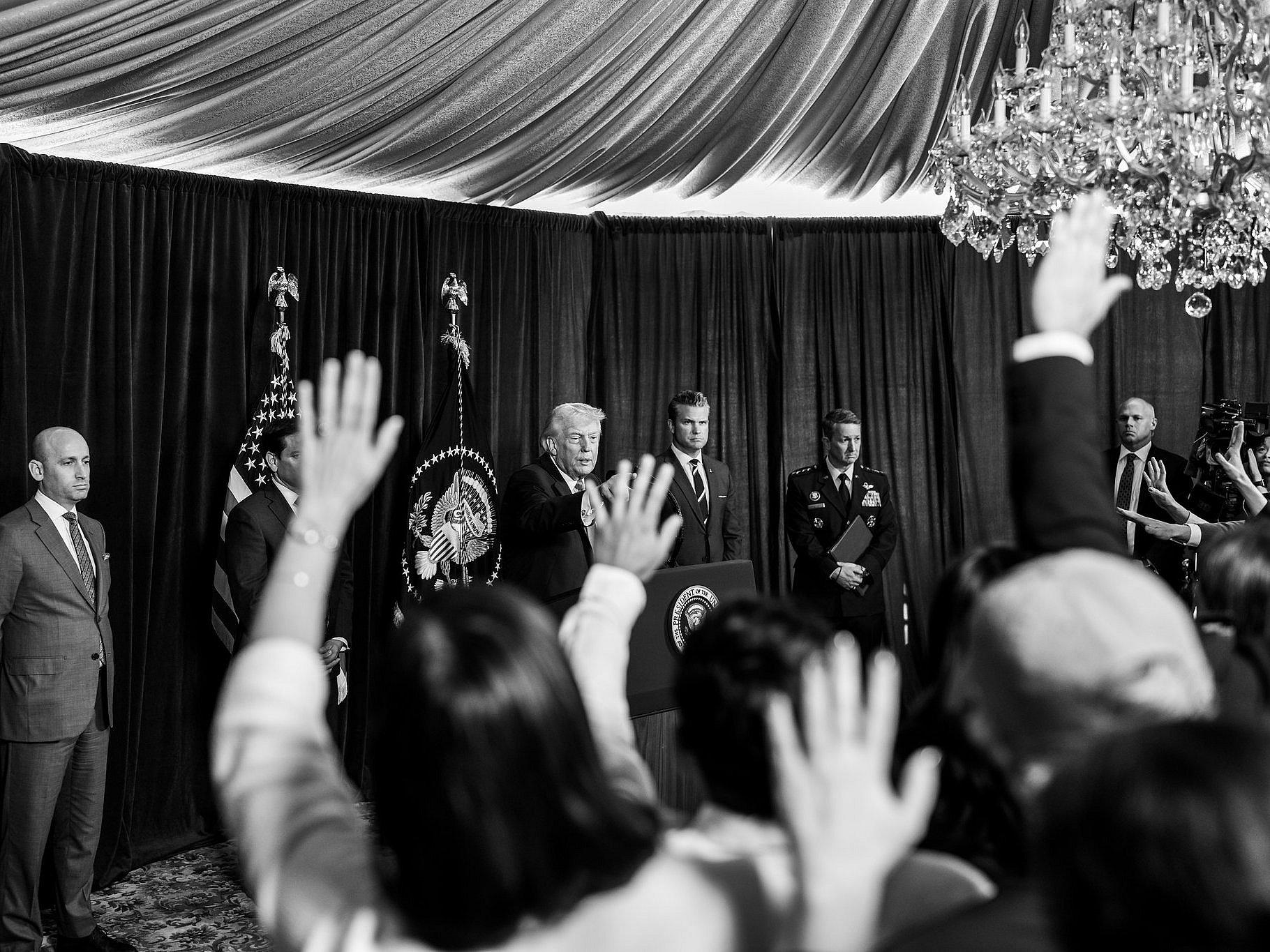
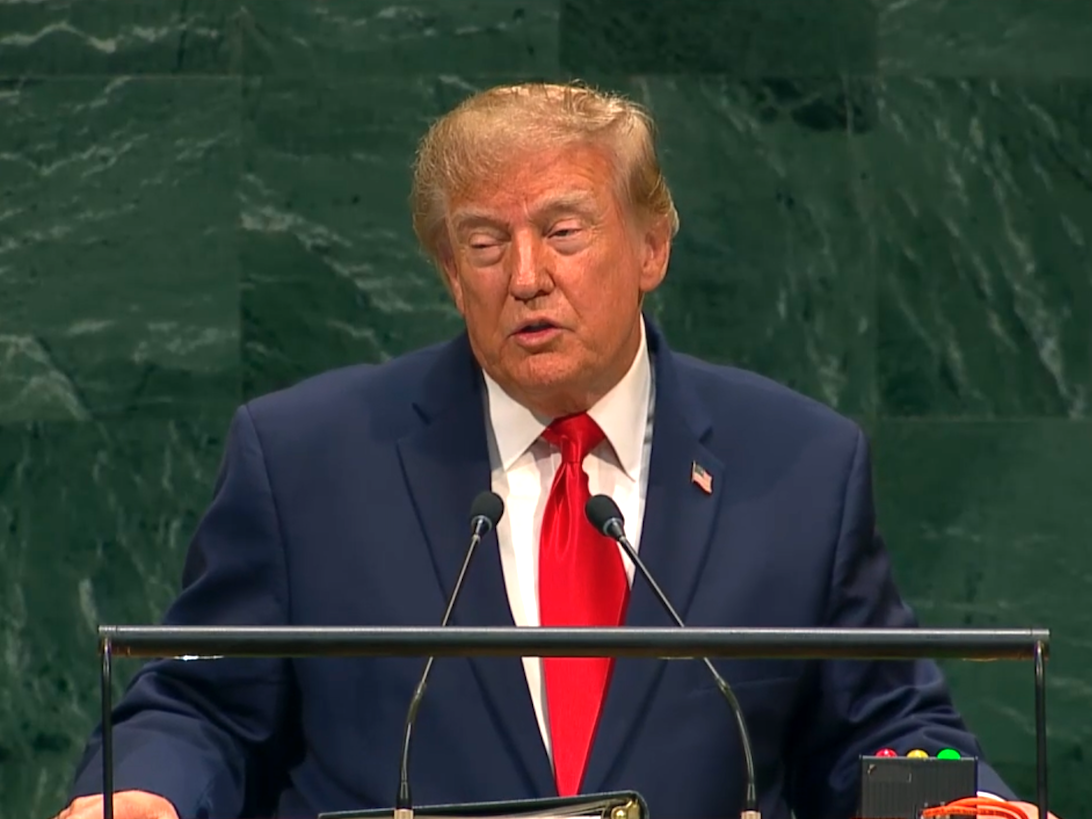
Asked about the expiration of New START during a Wednesday press conference, Rubio said he didn’t “have any announcement” on the matter, and that President Donald Trump “will opine on it later.”
“Obviously, the president’s been clear in the past that in order to have true arms control in the 21st century, it’s impossible to do something that doesn’t include China because of their vast and rapidly growing stockpile,” Rubio said.
New START, signed in 2010, committed the United States and Russia to halving the number of strategic nuclear missile launchers in their arsenals.
While the treaty did not limit the size of the countries’ actual nuclear arsenals, proponents pointed to its robust verification regime and other transparency features as mutually beneficial highlights of the agreement.
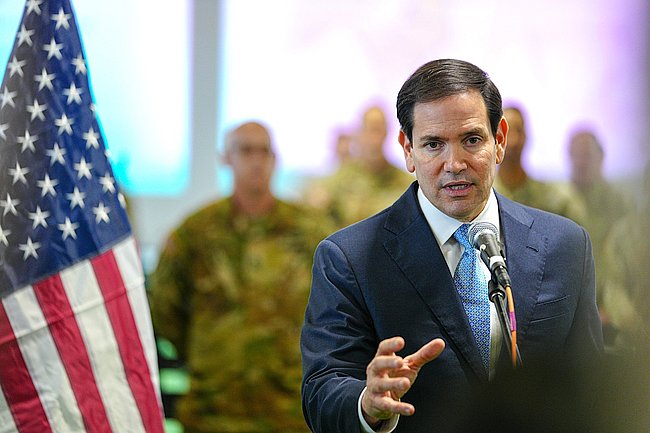
U.S. Secretary of State Marco Rubio visiting the Civilian Military Cooperation Center in Kiryat Gan, Israel, Oct. 24, 2025.
“We have known that New START would end for 15 years, but no one has shown the necessary leadership to be prepared for its expiration,” said John Erath, senior policy director at the Center for Arms Control and Non-Proliferation and a former longtime State Department official.
“The treaty limited the number of nuclear weapons the United States and Russia could have, but perhaps more importantly, New START also provided each country with unprecedented insights into the other’s arsenal so that Washington and Moscow could make decisions based on real information rather than speculation,” Erath added.
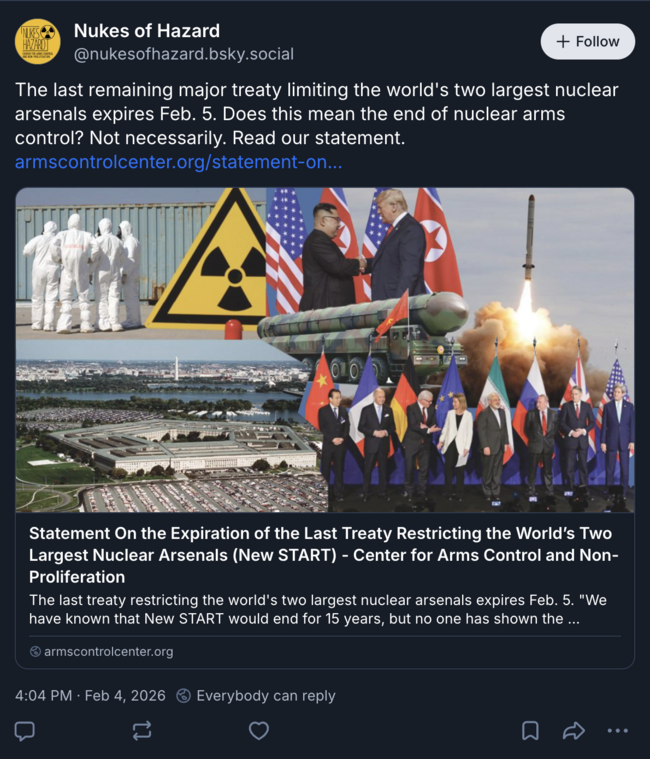
Daryl G. Kimball, executive director of the Arms Control Association, said Wednesday “the end of New START requires a more coherent approach from the Trump administration.”
“If President Trump and Secretary Rubio are serious, they should make a serious proposal for bilateral (not trilateral) talks with Beijing,” he asserted. “Despite Trump’s talk about involving China in nuclear negotiations, there is no indication that Trump or his team have taken the time to propose risk reduction or arms control talks with China since returning to office in 2025.”
Kimball said:
“Furthermore, there is no reason why the United States and Russia should not and cannot continue, as [Russian President Vladimir] Putin suggested on September 22, to respect the central limits of New START and begin the hard work of negotiating a new framework agreement involving verifiable limits on strategic, intermediate-range, and short-range nuclear weapons, as well as strategic missile defenses.
At the same time, if he is serious about involving China in “denuclearization” talks, he could and should invite [Chinese President Xi Jinping] when they meet later this year, to agree to regular bilateral talks on risk reduction and arms control involving senior Chinese and U.S. officials.”
“With the end of New START, Trump, Putin, and Xi can and must put the world on a safer path by taking commonsense actions to build down the nuclear danger,” Kimball added.
Erath lamented that “with New START’s expiration, we have not only lost unprecedented verification measures that our military and decision-makers depended on, but we have ended more than five decades of painstaking diplomacy that successfully avoided nuclear catastrophe.”
“Agreements preceding New START helped reduce the global nuclear arsenal by more than 80% since the height of the Cold War,” he noted. “Now, both Russia and the United States have no legal obstacle to building their arsenals back up, and we could find ourselves reliving the Cold War.”

Doomsday clock, positioned at 85 seconds minutes to midnight in January 2026.
Last week, the Bulletin of the Atomic Scientists’ Science and Security Board advanced its symbolic Doomsday Clock to 85 seconds to midnight, the closest it has ever been to global thermonuclear annihilation, citing developments including failure to extend New START, China’s growing arsenal, and Russian weapons tests — to which Trump has vowed to respond in kind.
“The good news is,” said Erath, is that “the end of New START does not have to mean the end of nuclear arms control.”
“While New START can’t be extended beyond today, Presidents Donald Trump and Vladimir Putin could decide to respect the numerical limits the treaty set on nuclear arsenals,” he explained. “They could also resume the treaty’s data exchanges and on-site inspections, in addition to implementing verification measures from other previous arms control treaties.”
“Further, they could instruct their administrations to begin immediate talks on a new treaty to cover existing and novel systems and potentially bring in other nuclear powers, like China,” Erath continued.
“Meanwhile, Congress could — and should — fund nonproliferation and global monitoring efforts while refusing to fund dangerous new nuclear weapons systems.”
Last December, U.S. Sens. Ed Markey (D-MA) and Jeff Merkley (D-OR) and Reps. Don Beyer (D-VA), John Garamendi (D-CA), and Jim McGovern (D-MA) reintroduced the bicameral Hastening Arms Limitation Talks (HALT) Act, “legislation outlining a vision for a 21st century freeze on the testing, production, and deployment of nuclear weapons.”
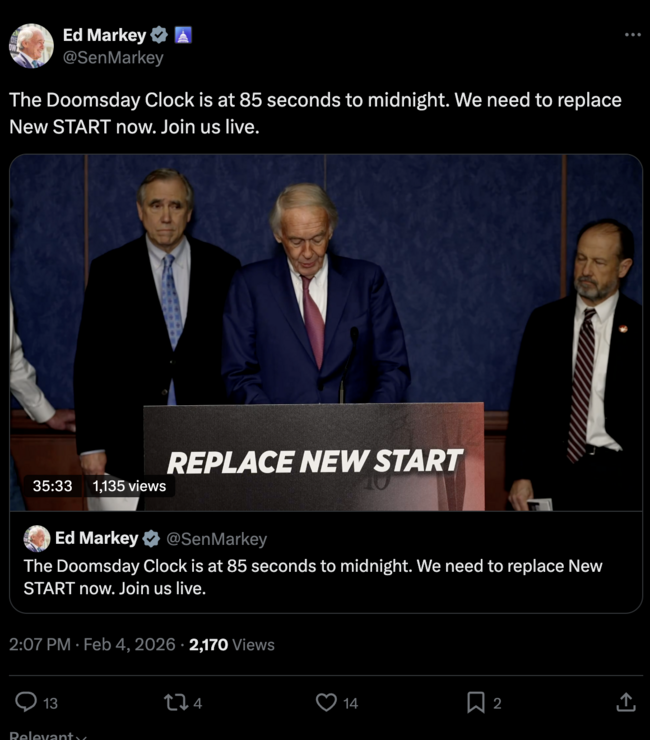
“The Doomsday Clock is at 85 seconds to midnight,” said Markey — who co-chairs the congressional Nuclear Weapons and Arms Control Working Group. “We need to replace New START now.”
Source: Consortium News.