European politicians are once again — for the third time in a little over a hundred years — leading Europe blindly into a new war.
Incredible, yet true, it’s similar to the run up to the First World War.
History, in the case of Europe, is proving to be a poor teacher.
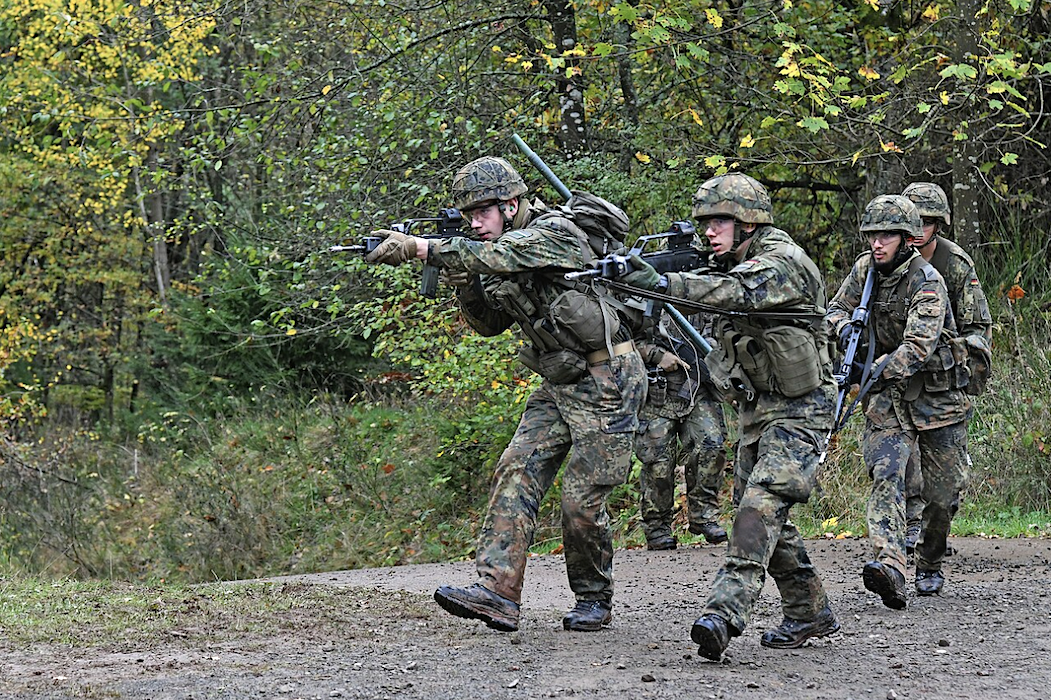
The latest confirmation of this drive towards war is the European Commission’s recent proposal for a so-called war Schengen, which would enable practical movement across European borders of its armies toward the East, without requiring the consent of individual E.U. member states.
This contradicts the principle of member state sovereignty and the fundamental acts of the European Union.
According to Kaja Kallas, high representative for foreign affairs and security policy of the E.U.:
“The fast movement of Europe’s militaries is essential for Europe’s defence. Defence readiness fundamentally depends on whether you can get your tanks and troops to where you need them, when you need them. Europe is facing unprecedented security threats. The case for better military mobility couldn’t be clearer.”
Diplomacy — supposedly her core activity — has been completely forgotten by the former Estonian prime minister. “War, war, and preparations for war” is today the slogan of Europe’s leading political elites.
At the epicentre of this development is once again the two most powerful European countries: Germany and Russia.
The warning of German “Iron Chancellor” Otto von Bismarck, architect of the European balance of power at the end of the 19th century — just prior to the First World War — has been forgotten: that peace in Europe depends on stable relations between Germany and Russia.
Germany’s current Minister of Defence Boris Pistorius (a man with a Russian name), whose country is expected to have the strongest army in Europe within a few years, announced that Russia could decide as early as next year to attack some of the most exposed NATO states, and certainly by 2028.
The Wall Street Journal reported on Nov. 26 that two and a half years ago, Germany developed a secret plan for war with Russia.
The success of this large-scale military operation, codenamed OPLAN Deu, with as many as 800,000 German, American, and other NATO soldiers, would — according to the 1,200-page document — depend on infrastructure that is now being intensively modernised. Soldiers are being rapidly prepared for war.
French Army Chief of Staff Fabien Mandon declared recently, to the general outrage of the public, that France “must be prepared to accept the loss of its children” if it wishes to effectively deter the Russian “threat.”
E.U. Commissioner for Defence Andrius Kubilius, a Russophobic Lithuanian politician, shares this view. He would turn Ukraine into a new military frontier presumably to protect Europe against a Russian attack, just as it defended against Turkish invasions in the past.
This is one of the official reasons for the current militarisation of the E.U. and the declared long-term arming of Ukraine.
Europe Must Win at Any Cost
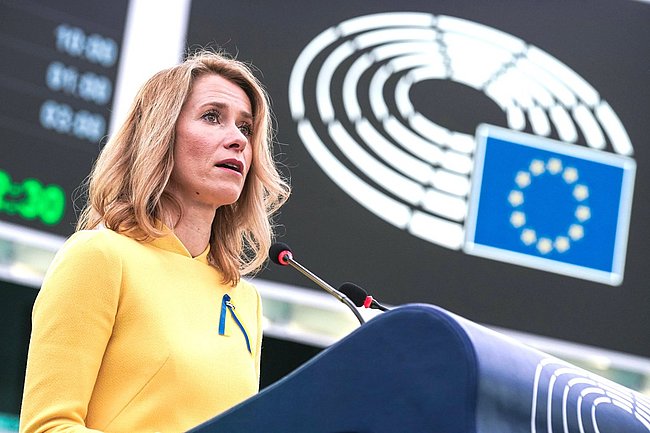
Kaja Kallas in European Parliament on March 9, 2022, calling for more EU defence, reduced energy dependence on Russia and solidarity with Ukraine.
The official Western doctrine claims that Russia carried out aggression against Ukraine, thereby flagrantly violating international law and the U.N. Charter, while completely ignoring the fact that the war is a consequence of NATO’s expansion into the former Soviet Union space and a gross violation of the basic rights of the Russian-speaking population of Ukraine.
According to the White Paper for European Defence – Readiness 2030, published in March this year, the future of Ukraine is fundamental to the future of Europe as a whole. The war’s outcome will be a factor determining the E.U.’s future.
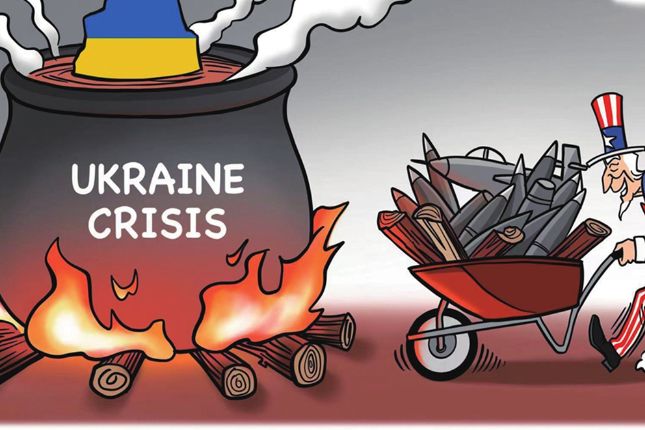
Europe must therefore win at any cost, in the opinion of Kallas and her superior Ursula von der Leyen, the European Commission president. For this reason, the coalition of so-called “willing European states,” led by Britain, Germany, and France, rejected the 28-point peace plan of U.S. President Donald Trump, who — despite hesitation and frequent changes of position — finally concluded that the war in Ukraine cannot be won and could lead to a nuclear confrontation between the United States and Russia.
By contrast, the leading European states, despite having lost wars to Russia in the past, insist on continuing the Ukraine war until a nearly impossible victory under the assumption that otherwise Russia will attack Europe.
A sober person asks to what extent are such claims realistic, and whose interests are served by predictions of a new, third general European war in little more than a century? The answer is clear: to politicians who have led Europe into its current nearly hopeless situation.
But even if Russia wanted to attack Western Europe, it lacks the resources. For one, it is moving toward the demographics of an “aging society”: fewer children, more elderly, and a shrinking labour force. The total fertility rate of 1.41 children per woman as of 2024 is one of the lowest in decades. Russia’s median age is 42 years.
Russia’s considerably smaller economic and human potential – 145 million inhabitants compared to Europe’s roughly 450 million; Russia’s nominal GDP of around $2 trillion compared to the E.U.’s combined GDP of roughly $16–17 trillion — indicates that Russia clearly cannot conduct a successful attack on NATO member states, even if it wanted to.
Another reason is that European NATO members alone already allocate approximately $380–420 billion (2024) for armaments, while all NATO members together with the United States allocate USD $1.34–1.45 trillion.
Russia, despite being at war, allocated only around $149 billion for military expenditures in 2024.
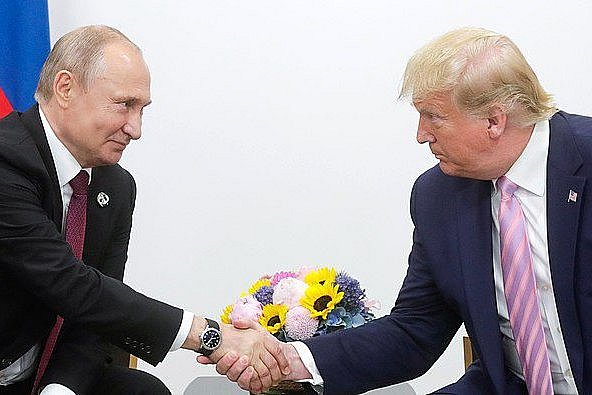
Russian President Vladimir Putin last week dismissed predictions of Russia attacking NATO as “ridiculous” and offered to formalize it in a non-aggression pact.
“Russia does not intend to attack Europe. To us, that sounds ridiculous, does it not?” he told a press conference in Bishkek, Kyrgyzstan. “We never had any such intentions. But if they want to have it formalised, let’s do it, no problem.”
The Economic Backlash

Volkswagen factory in Wolfsburg, Germany, 1960. The town was built to house the WV workers.
The eagerness of leading European political elites to continue the war in Ukraine is partly the result of the systemic decay of the E.U. as a democratic institution.
The E.U. has so far been unable to formulate even a single peace initiative to end the war in Ukraine; moreover, due to the entirely one-sided policy embodied by the misguided strategy of 19 sanction packages against Russia, it is facing increasing deindustrialisation.
Industrial production in Germany, for example, has fallen to levels last seen 20 years ago. Numerous technology companies, especially German ones, are relocating their production to the United States, where business conditions are significantly more favourable.
With energy prices up to five times higher for U.S. imports compared to Russian ones, European industry can no longer compete on the global market, increasingly dominated by Chinese and other successful companies from the global South.
Leading European politicians, relying on an obsolete export model — confirmed by the drastic decline in German car exports to China — can no longer launch a new development cycle.
Therefore they have turned to so-called war Keynesianism, based on the idea that governments can stimulate economic growth through increases in public spending, which include armaments.
Depending on a War Economy
Adolf Hitler followed this pattern before the Second World War; and in the United States the consequences of the Great Depression were eliminated only through the rapid growth of a war economy.
Trump, in his efforts to achieve the goals of the MAGA movement, therefore has not accidentally ordered all NATO member states to increase defence expenditures to 5 percent of their GDP. European political elites followed this command without resistance so that, by creating a warlike atmosphere and high profits for the arms industry, they could more easily stay in power.
Since weapons production is not dependent on market conditions — prices are set by manufacturers, not by the market or consumers — weapons are becoming increasingly expensive. This allows the largest producers, for example in the United States, Germany, and other major European arms manufacturers, to boost economic growth and temporarily halt economic decline.
In Germany, economic growth will this year be less than one percent for the third consecutive year.
It is therefore no coincidence that Germany and other leading European states are not interested in ending the war in Ukraine, but in its continuation, since only by fueling tensions can they maintain higher economic growth based primarily on the arms industry.
In most other industrial sectors, for example in the once-iconic European automotive industry, the E.U. has already lost the battle to Chinese producers. Instead of investing financial resources in research and development for civilian purposes, European states will primarily fund military research.
War Keynesianism works only in the short term. This is also confirmed by the fact that Russia’s economic growth has also begun to fall. The same will happen in Europe after a few years.
Different Leaders

President Volodymyr Zelensky in Kiev on May 10, 2025.
The only way out of this crisis is for new leadership at the helm of the most powerful European countries and at the E.U., both of which are rapidly losing legitimacy because of their militarism.
According to the latest European polls, French President Emmanuel Macron is supported by less than 15 percent of French voters; Prime Minister Keir Starmer by less than 20 percent of British (with almost three quarters rating him negatively), and German Chancellor Frederic Merz, despite having been in office only a few months, is supported by only around 25 percent of Germans.
In these three leading European countries, which are in serious economic trouble, changes of power will likely occur within the next year or two. That would significantly influence the political situation in Europe.
Increasingly militant political elites are losing public trust. No European poll indicates that the public supports war or extreme militarisation.
Germany’s leading opposition party, the AfD, for example, advocates an end to the war in Ukraine, reform of the U.N. system to reflect the changed balance of power in the world, and democratic reform of the E.U., or German withdrawal from it if this is not achieved.
The First European Dictator

Ursula von der Leyen at a NATO defense minister session in 2019.
Similarly detached from political reality are the (unelected — this must be emphasised) leading E.U. officials. The most drastic examples are von der Leyen and Kallas who are the staunchest proponents of militarisation.
The commission president announced in her State of the Union speech this September a series of important changes in this direction. If implemented, the E.U. will become an authoritarian, centralised, and militaristic organisation.
Among other things, von der Leyen announced a gradual abolition of the principle of unanimity of major E.U. decisions (first in foreign policy). Abandoning this principle would be the first significant step toward forming a federal E.U. structure, i.e., abolishing the sovereignty of individual states.
Small states would be in a markedly subordinate position, as larger countries with larger populations could decide E.U. policy on their own. The Hungarian prime minister Viktor Orban would then be only a voice crying in the wilderness.
Von der Leyen also strongly advocates the adoption of the war Schengen. In this case, the member states could be dragged into wars against their will (Hungary has already stated that it will not allow military passage through its territory for a potential confrontation with Russia).
She is in favour of increased integration of the European military industry and — due to growing tensions between the United States and the E.U.— gradual formation of a common European army.
The E.U. is transforming from a political and economic union into a military alliance.
Under the proclaimed “commitment to democratic resilience,” announced by the commission president in her September address, is the cover ambition to introduce general media censorship. Measures are moving in this direction ostensibly aimed at preventing hate speech or child pornography,that include obligatory control of e-mails and other digital communications on the Internet.
The ultimate peak of the Orwellian model of a fully monitored society is her proposal to establish a central E.U. intelligence service, a kind of “European C.I.A.,” personally subordinated to her. Clearly von der Leyen is aiming to become the first European dictator.
She and her associates, with the support and servility of leading European politicians, are evidently preparing for the introduction of a modern European dictatorship sui generis. So far there is little debate in European media about these alarming issues.
EU Pulling Apart

The European Union flag in the European Parliament in Strasbourg.
The differing positions inside the E.U. regarding the war in Ukraine are, nevertheless, increasingly coming to the surface.
The southern Mediterranean bloc of states, for instance, does not support Poland and the Baltic states in escalating tensions with Russia; the group of Central European countries — Hungary, Slovakia, and likely soon after recent elections also the Czech Republic — rejects unconditional diktats from Brussels; while the core group of states, embodied by Germany and France, flexes their muscles in confrontation with Russia, partly because of domestic politics.
The intention of the “coalition of the willing” to confiscate seized property of the Russian central bank in Europe further deepens these divisions, as all E.U. member states, as guarantors, could be affected.
Instead of diplomacy, European states are clinging to patterns that they had once abandoned during the Cold War.
This is confirmed by the fact that two important European organisations have been sidelined: the Organization for Security and Cooperation in Europe (OSCE) and the European Free Trade Association (EFTA).
The OSCE should become a key player in shaping a new security structure of peace in Europe, and the EFTA is an exemplary organisation that promotes comprehensive economic cooperation and has no ambition to become a new supranational structure—unlike the E.U. under its current leadership.
EFTA will certainly be a potential alternative for E.U. member states that do not agree with the current centralist and autocratic orientation of the E.U. Contradictions within the E.U. will intensify when new members are admitted, as subsidies to current members —especially in agriculture and cohesion funds — will decrease substantially.
There is a danger that the E.U. will follow the path of disintegration, just like the former Yugoslavia.
Europe, which was the dominant world power for almost five centuries, has slipped to the periphery, even though the elites leading it refuse to admit it. The outcome of the war in Ukraine will undoubtedly affect the E.U.
Peace is in the interest of Europe, Ukraine, and Russia alike. Total victory will not be possible; war Keynesianism will affect both Europe and Russia, as evidenced by the gradual decline of economic growth in Russia too, which may cause internal tensions.
The war will end at some point, but this does not mean that peace will prevail. Given the entirely opposite positions of both warring sides, there is a strong likelihood that a frozen conflict will evolve in Eastern Europe for a long time. It can only be resolved through dialogue.
Peace in Europe is not possible without the cooperation of all powers. The exclusion of Russia and Germany from the Paris Peace Conference of 1919 had tragic consequences for the entire world. Repeating this mistake could be fatal.
Source: Consortium News.