“We are just so shocked,” a German friend residing in Switzerland wrote the other day. “These cases affect us very much, as they will have consequences for us all.”
What cases would these be, you may wonder. What cases and what consequences?
You may especially wonder about cases and consequences if you are an American reliant on corporate media: Europe is convulsing as the “centrist” authoritarians who purport to lead it impose what looks to me like an historically unprecedented regime of censorship and the suppression of speech, but none of the mainstream dailies or broadcasters in America have had a word to say about it — a point to which I will shortly return.
It was the case of Jacques Baud that prompted my German friend’s distress — or radically escalated it, better put, for she had had an other-than-sanguine view of Europe’s drift toward tyranny long before news of Baud’s fate broke. And so, to some particulars.
Jacques Baud is a Swiss citizen now residing in Brussels. He was formerly a colonel in the Swiss army and served for many years as an analyst in Swiss intelligence and in the Swiss Foreign Ministry. He has held senior positions at the United Nations and was more recently an adviser to NATO covering Ukrainian affairs.
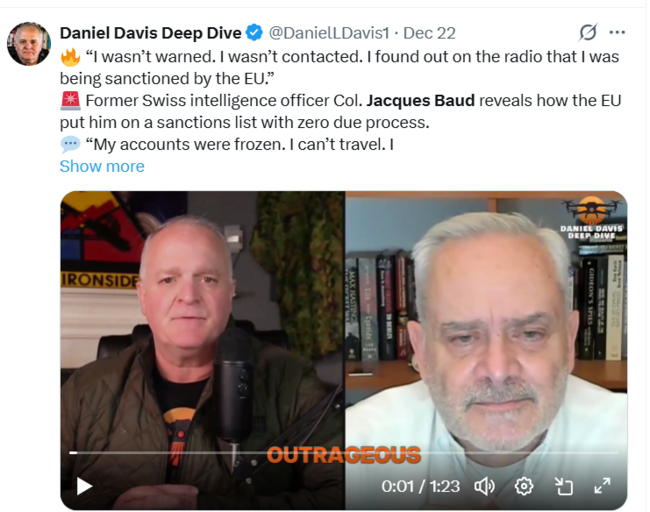
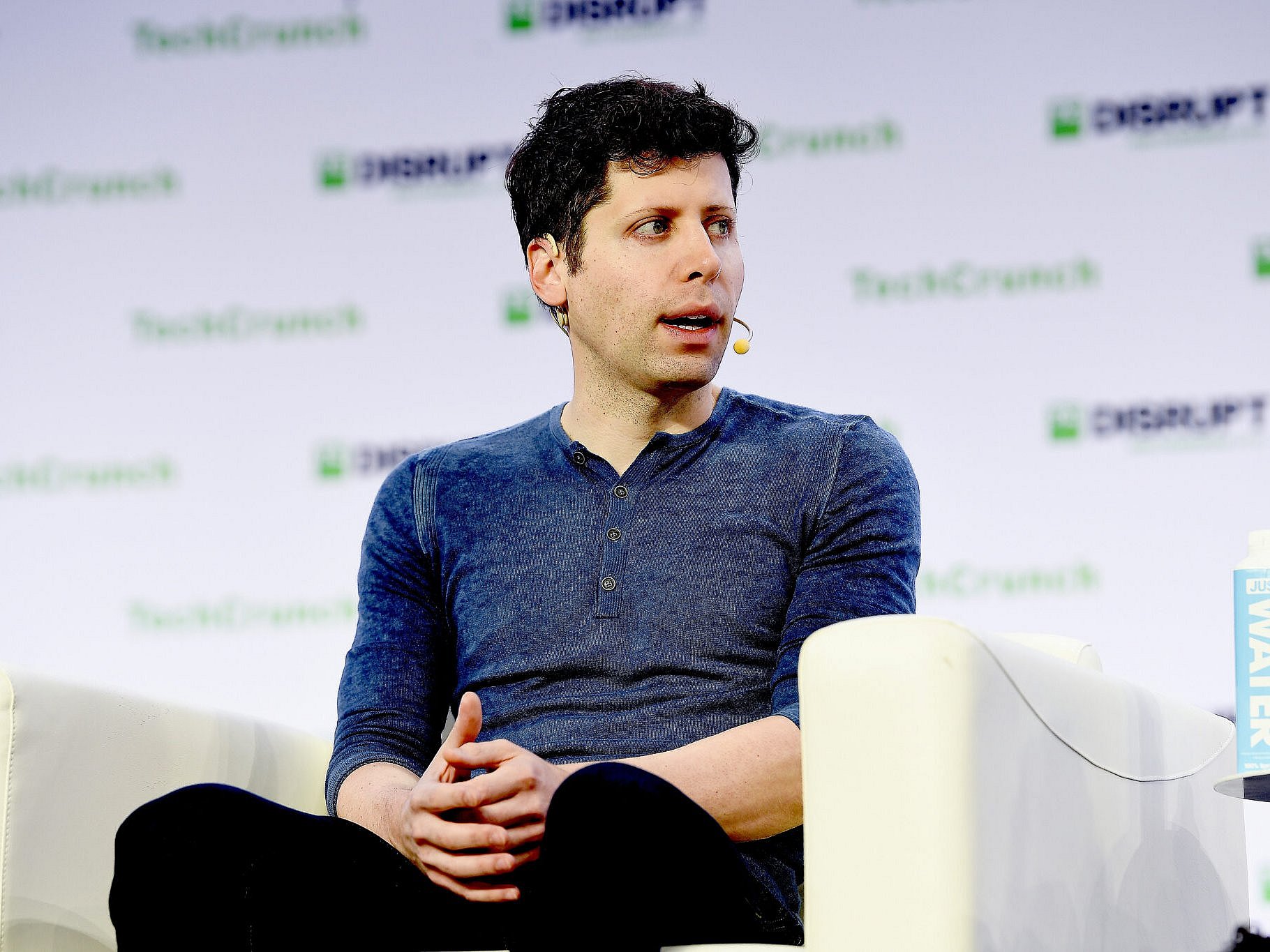
Former Swiss intelligence officer Col. Jacques Baudbaud interviewed by Lt. Col. Daniel Davis, December 2025.
Baud is now 70 and has for some years applied his exceptional expertise to analysis and commentary on war, peace, geopolitics, and affairs of state, work that has earned him a reputation for insight and integrity.
His most recent books are The Russian Art of War: How the West Led Ukraine to Defeat and Operation Al–Aqsa Flood: The Defeat of the Vanquisher, which explains the events of Oct. 7, 2023 by way of Israel’s incessant breaches of international law over 75 years. Max Milo Editions, a small French house, brought out both books last year.
On Dec. 15, the European Union imposed sanctions on this distinguished man. He is now on the E.U. Sanctions Tracker, which lists the names and offenses of those the E.U. has summarily blacklisted. Here is Baud’s entry on this truly diabolic website:
“Jacques Baud, a former Swiss army colonel and strategic analyst, is a regular guest on pro–Russian television and radio programmes. He acts as a mouthpiece for pro–Russian propaganda and makes conspiracy theories, for example accusing Ukraine of orchestrating its own invasion in order to join NATO.”
Disinformers Denounce Disinformation
We are now in the land wherein those who propagate disinformation assert that they are countering “disinformation,” and let us observe our quotation marks, for “disinformation,” in Baud’s case as in many others, means accurate information.
If you can follow.
To net this out, Jacques Baud has written thoughtfully and extensively on the war in Ukraine and its bearing on relations between Russia and the West. This includes a sound analysis of NATO’s advances to the Russian Federation’s borders, the U.S.–orchestrated coup in Kiev in 2014, the West’s subsequent betrayal of the Minsk Protocols, and the Biden regime’s purposeful provocation of the military intervention Russia began not quite four years ago.
Whether or not one agrees with Baud’s take on this or that question, his is well-supported work. And the E.U. has just comprehensively sanctioned him for it.
Any European now risks the same if, to bring this home with an especially egregious example, he or she states perfectly discernible truths as to what prompted Moscow’s “special military operation” in February 2022. If invited to make this case on a Russian television station, the offender is yet further beyond the pale.
There are other aspects of the Baud case that have paying-attention Europeans in an uproar. Baud has not been charged with any criminal offense. There has been no investigation into his work, no evidence has been presented, there will be no judicial process, and he will have no opportunity to respond to the “case” — quotation marks again — the E.U. makes against him.
The sanctions he now faces were imposed in an exercise of extrajudicial — as in unlawful — power. As Costas Lapavitsas, a professor at S.O.A.S. (School of Oriental and African Studies, University of London), put it in a piece in Brave New Europe, published Christmas Eve, “An individual was punished by executive designation alone.”
“Baud has not been charged with any criminal offense. There has been no investigation into his work, no evidence has been presented, there will be no judicial process, and he will have no opportunity to respond to the ‘case’ … the E.U. makes against him.”
We have all read endlessly about sanctions and how much or little they matter, but in Baud’s case — and there are others facing this designation — they are grave.
Baud’s assets are now frozen in the E.U. and he cannot travel. He cannot access his bank accounts and various sources of income are blocked. As of now it is a criminal offense to transact with him — to sell him a house or groceries, to take in his shirts, to repair his car. “Although the regulation allows minimal subsistence payments,” Lapavitsas writes, “the effect is to paralyse a person economically and professionally.”
The Baud case is horrific all by itself, and so I give it generous column inches, but it is horrific times ten when we consider its larger implications — its “consequences for us all,” as my German friend put it.
Censorship and attacks on free speech are nothing new on either side of the Atlantic, to state the obvious. It is two years this coming spring since Germany refused entry to Yanis Varoufakis, the honorable Greek economist and activist, who was to attend a congress on Palestine in Berlin.
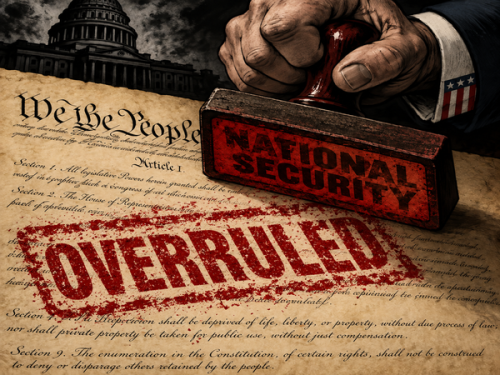
The Biden regime was notable for its connivances with Silicon Valley and its assaults on free speech. These have worsened dramatically during the first year of Trump II.
It comes time to understand our moment for what it is — the circumstance now upon us.
The Western order is collapsing. This is no longer a matter of interpretation or hyperbole or a figure of speech or a commentator’s shorthand. It is the reality within which we have to live.
The “centrist” regimes defending the gross disorder they insist is a “rules-based order” have tipped this past year toward a state of desperation. As Alastair Crooke put it in a piece published this past autumn, ours is “a new era of coerced dominance.”
In a holiday note the other day, Chas Freeman referred to “our new Dark Age.” This already proves a perilous time. “Today it is war without limits — without rules, without law,” Crooke writes. “Ethical boundaries, more particularly, are dismissed in parts of the West as ‘weak.’”
Where does this place the front line for those committed to resisting this swift drift toward lawlessness and tyranny in the cause of a moral and just world? I think it must be in defense of free speech.
The cases in point accumulate like fallen leaves around us.
As I was considering the ramifications of Jacques Baud’s travails, the condition of those hunger-striking in behalf of Palestine Action worsened. At writing, eight of those striking are at risk of fatal organ failure for insisting with their bodies on the direct-action group’s right to protest without being proscribed as “terrorists.”
And then the case of Greta Thunberg, who was arrested in a London street just before Christmas for holding a placard that read simply, “I support the Palestine Action prisoners. I oppose genocide.” Thunberg is now out on bail until March, presumably to face charges under Britain’s preposterously antidemocratic Terrorism Act.
There is post–Bondi Beach Australia, where the New South Wales government now has the power to ban protests for up to three months — along with “hate speech” and “prohibited symbols.”
This following may seem a small matter, but it is a daily occurrence in Germany now and so betokens an emergency: A day or two before Christmas an “X” account under the name Irlandarra posted a video of a young man sitting at a café in Berlin when German police yank him out of his seat and arrest him. His offense was wearing a T–shirt with a Palestinian flag on it while talking quietly with friends.
There is an argument that the Europeans, who have gone right off the rails in any number of directions, their obsessive Russophobia and their criminalization of any critique of Israeli terror merely two of them, are out front in their suppression of free speech.
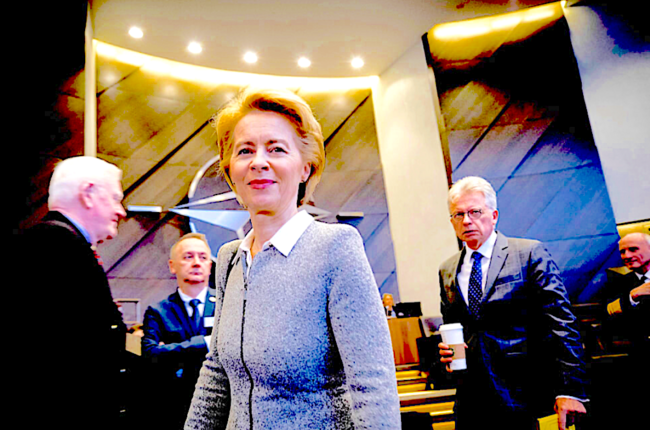
Ursula von der Leyen at a NATO defense minister session in 2019.
Ursula von der Leyen recently gave a speech casting “information manipulation” as a virus and censorship as the required vaccine. “Prebunking” (as against debunking) is her term for this. O.K., the European authorities are using law to take the suppression of speech to an alarming extreme. But it is the same in America by other, less overt means.
You have read nothing in America’s mainstream press about the Jacques Baud case. Shockingly, there has been not a word about the hunger strikes or Greta Thunberg’s arrest or the increasingly aggressive conduct of the police in Britain, Germany, and elsewhere.
There is a simple explanation for this: Americans are not to know or think about the advancing suppression of speech and the rise of popular resistance to this. It makes for an immense lump under the carpet, but let us not forget: Mainstream media in the United States have been vigorous supporters of censorship since the Russiagate years and, I will add, the emergence of independent media as a presence in public discourse.
Independent media, to finish the thought, will be essential to any successful defense of free speech as increasingly assertive authoritarians across the West seek to extinguish it altogether.
The Jerusalem Post ran an interesting story on Christmas Day under the headline, “Georgetown University severs ties with U.N.’s Francesca Albanese over anti–Semitic remarks.” The special rapporteur for Palestine was a visiting scholar at Georgetown until the university purged her at the insistence of U.N. Watch, one of those disgusting Zionist groups dedicated to discrediting critics of Israeli terror.
One of the United States’ most venerable universities now joins not only in suppressing the speech of a highly visible public servant but also in attacking a figure distinguished for her unceasing defense of international law. Speech, of course, has been Albanese’s instrument.
Trita Parsi, the executive v.–p. at the Qunicy Institute, posted a brilliantly pertinent comment on “X” in response to the Jerusalem Post piece: “They can’t win a single argument, so they rely on silencing people.”
A more succinct summation of our moment I cannot think of. To resist silencing: This seems to me the first task of our time. As the year turns this responsibility presses itself upon us ever more urgently and personally.
What Are the Consequences?
What actually occurs when speech is suppressed? Conferences are canceled, as in the case of Yanis Varoufakis, and professors are suspended or fired or monitored. Newspapers, online journals, podcasts: These and other media are censored, siloed into algorithm ghettos, or forced to cease publication altogether.
You are arrested for carrying a placard or for what is stenciled on your T–shirt. Instagram accounts and messages on “X” are blocked. Readers report that Facebook does not allow them to repost work published in Consortium News, where some of my work comes out.
All this is now common — not quite “normalized” but nearly. The other day the aforementioned Irlandarra posted an item on “X” quoting a basketball star named Dwight Howard:
I tweeted Free Palestine. Less than 10 minutes later, I got a call from the NBA. Commissioner, agents, people in my foundation, and even folks from Texas, telling me to take it down. I damn near got kicked out of the league for it. And I’m trying to figure out, Why?!
In one or another way, and in all such cases, the free use of language is forbidden. O.K., obvious enough. But what else happens?
As I considered this question and what more there is to it my mind went back to L.S. Vygotsky, the noted Soviet psychologist, who died in 1934 aged 37 (and whose works were suppressed until Stalin’s death in 1953). The brilliant Vygotsky developed his highly original argument in his most famous book, Thought and Language (sometimes Thinking and Speech in translation).
The primary function of language is not speech, Vygotsky discovered in his researches: It is thought. Jean Piaget considered this question a little later, and more years later so did Chomsky. Speech as we think of it follows “inner speech,” our language when we talk silently to ourselves, and then egocentric speech, when, as Piaget had it, young children talk aloud in languages known only to them.
It followed in Vygotsky’s theory that words are actions, an idea often associated with the Russian scholarly tradition: As language gives form to thought, thought eventuates in behavior, what we do. And so we come to the true and grave import of the threatening assaults on speech that confront us across the Western world.
Most immediately, to suppress speech is to suppress action. This is manifestly the intent of the authoritarians in Europe, in the United States, in Australia. If there is no speaking of Israeli atrocities or the true causes of the war in Ukraine or the apparently imminent attack on Venezuela there will soon enough be no objection to these things.
This is key to the process of “normalization.” The daily brutalities in Gaza, to take the obvious example, fall off the front page, people speak of them no longer, and resistance to them weakens to the point of vanishing.
No thought, no speaking, no action — a process major media incessantly reinforce. So does a grotesque, morally bankrupt silence descend upon us.
More than this, the suppression of speech transforms the future into a desolate tundra. Censoring speech, we need to know and never forget, amounts to thought control at one short remove.
When all alternative opinions and perspectives are effectively outlawed they survive only among the tenacious few and only underground — a term we ought to revive and get used to using. On the surface of life, where the orthodoxies reign, there are no alternative opinions or ways of seeing things.
To extend this thought, when authoritarian regimes posing as defenders of democratic rights ban free speech and, so, free thought, we are effectively confined like detainees in the prison of an eternal present — this the consequence when envisioning a different future is made a prohibition. Creativity, imagination, zones of possibility, and ultimately change — all are rendered beyond reach.
This is one of Huxley’s points in Brave New World. The “what-is,” as I call it, is all there is or will be. The administration of Soma, the state-provided drug that transports those who take it into an anaesthetized euphoria, becomes essential to social control. We should think of this as we consider the prevalent assaults on free expression.
The New York Times or any like mass-circulation daily fill their pages with all the things you must have and all the romance novels you must read and all the casserole dishes and cocktails you must try. This is more than mere frivolity: They offer readers their daily dosages on Soma. Those who are supposed to stand tallest for free speech now numb their readers to its absence.
It is time: Let us determine vigorously to speak in the year to come while accepting what consequences speech may impose, and I will come to those in the piece to follow.
Source: Consortium News.